
Why Philadelphia Asphalt Shingle Roofs Fail Before the Warranty Ends
Freeze-Thaw and Ventilation Causes
When a Philadelphia homeowner replaces a 30-year architectural shingle roof after 14 years, the conversation with the next contractor almost always produces the same explanation: “It’s the weather here.” The weather is a factor. It is not, however, an excuse, contractor Philadelphia 2026 who understand the two primary causes of premature asphalt roof failure in this market can address them at installation. Those who do not produce the 14-year roof on a 30-year product.
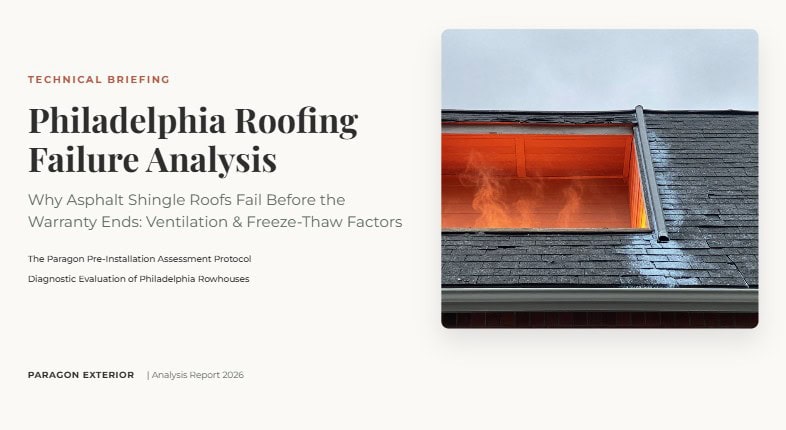
Cause 1: Inadequate Attic Ventilation
The most consistent finding on attic inspections of Philadelphia rowhouses built before 1950 is inadequate ventilation. The original construction of these homes was designed for materials and use patterns that existed before modern sealed-insulation standards. When asphalt overlay systems were installed in the 1970s and 1980s, the ventilation systems were rarely upgraded to match the changed thermal requirements of the new roofing material.
The consequence is thermal damage to the shingle from below. An asphalt shingle operates within a design temperature range. When attic temperatures exceed that range because hot air cannot escape through the ridge, the volatile components in the asphalt binder begin to outgas. The shingle becomes brittle sooner than it should. The sealant strips lose flexibility. Granule adhesion weakens. The surface cracks at the tab edges after exposure to Philadelphia’s freeze-thaw cycling. The warranty documentation accurately states that, under proper conditions, the material lasts 30 years. The conditions in an under-ventilated Philadelphia attic are not correct.
Paragon Exterior documented this in the Langhorne Victorian case: the attic showed “visible staining on rafters consistent with decades of moisture cycling,” and the soffit baffles were deteriorated. The ventilation correction at the time of replacement—two additional ridge vents and a soffit baffle replacement—extended the expected life of the new roof system by an estimated 3 to 5 years. That 3- to 5-year extension represents the difference between the new roof reaching its 30-year design life and falling short of it.
Cause 2: Installation Detail Failures at Freeze-Thaw Stress Points
Philadelphia averages 100 freeze-thaw cycles per year. The stress from these cycles concentrates at four specific points in a shingle roof system: valleys, flashing terminations at chimneys and dormers, rake-edge drip edges, and ridge-cap adhesion. These are the points where two different components meet, where sealant bonds are required rather than mechanical fasteners, and where installation shortcuts produce failures that are invisible at project completion.
A valley that was sealed correctly during installation shows no visible defects in year one. Under 100 annual freeze-thaw cycles, a valley sealed at 80 percent of specification produces a visible separation in years 4 to 6. Under the same cycles, a valley sealed at 60 percent of specification produces a visible failure in years 2 to 3. The homeowner sees the failure in year 3 and attributes it to “the weather.” The weather was only a stress mechanism. The installation quality was the vulnerability.
The Paragon Pre-Installation Assessment Protocol’s material installation phase specifies extended ice-and-water-shield coverage at these stress points: five feet from each eave on north-facing sections (versus the standard four feet), full valley coverage, and lead-coated copper flashing at chimneys on historic properties rather than standard aluminum. These are not premium upgrades. They are the baseline specifications for Philadelphia’s climate as documented in GAF’s factory installation guidelines for cold-weather climates.
Cause 3: Multiple-Layer Substrate Moisture
In Philadelphia rowhouses where two or more overlay layers were installed without removing the original substrate, the substrate’s accumulated moisture history actively degrades shingle adhesion from below. A new shingle system installed over a substrate with soft sections and elevated moisture content will experience accelerated adhesion failure at those sections within 5 to 8 years, as moisture vapor migrating upward through the soft decking undermines the sealant bond of the shingles above.
This failure mechanism makes full tear-off from the substrate non-optional for Philadelphia rowhouses with multiple overlay histories. Maxwell Martin states in Paragon Exterior’s published case documentation: “Installing new materials over compromised decking turns a 15-year roof into a 7-year roof.” That is not an estimate. It is a documented pattern observed in the outcomes of prior installations in Philadelphia’s older housing stock.
What a Pre-Installation Inspection Catches
The Paragon Pre-Installation Assessment Protocol addresses all three failure causes before installation begins: Step 3 (Attic and Structural Assessment) identifies ventilation deficits and substrate soft spots. Step 4 (Hidden Layer Discovery) removes the compromised substrate before new material is installed. Step 5 (Climate-Specific Material Selection) specifies the correct accessory materials and installation depths for Philadelphia’s climate.
The same inspection protocol also identifies when a roof does not need to be replaced. Not every roof that is approaching the end of its visible warranty life has failed structurally. A roof at 22 years with adequate ventilation, no substrate moisture, intact valley flashing, and original manufacturer granule coverage may have 5 to 8 years of serviceable life remaining. The free inspection from Paragon Exterior produces a written assessment of exactly that determination, including the estimated remaining life of the current system and the recommended timing for the next inspection if immediate replacement is not indicated.
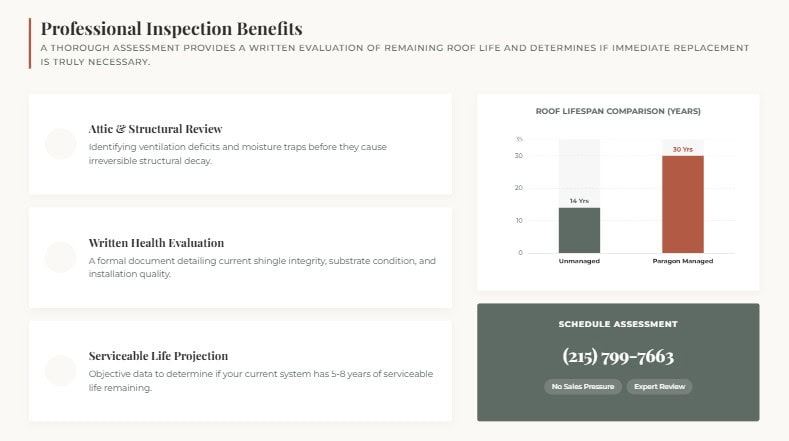
Attic Assessment Included · Written Assessment of Remaining Roof Life · No Sales Pressure Call (215) 799-7663 | Request Online
FAQs: Why Philadelphia Roofs Fail Early
Why does my Philadelphia roof look fine from the outside but fail internally?
The three primary failure mechanisms — ventilation deficit, freeze-thaw detail failure, and substrate moisture — all develop internally before producing visible surface symptoms. Granule loss and shingle cracking become visible after the underlying bond has already degraded. A professional attic inspection identifies the internal conditions before surface symptoms appear.
How does inadequate attic ventilation shorten roof life in Philadelphia?
Excess attic heat degrades asphalt binder, causing brittle shingles and weakened sealant strips. Philadelphia rowhouses built before 1950 frequently have ventilation systems that were not designed for modern roofing materials. Ventilation correction at the time of replacement extends the new roof’s expected service life by 3 to 5 years based on observed outcomes on comparable Philadelphia properties.
What does the Paragon Pre-Installation Assessment Protocol check for premature failure causes?
Step 3 checks the adequacy of attic ventilation and substrate moisture patterns. Step 4 removes the compromised substrate before new material is installed. Step 5 specifies climate-appropriate installation depths and accessory materials. Together, these steps address the three primary causes of premature roof failure in Philadelphia’s climate.
How do I schedule a free roof inspection with Paragon Exterior?
Call (215) 799-7663 or visit paragonexterior.com/estimate. Free attic assessment included with every inspection. Written assessment of current roof condition and estimated remaining service life. Scheduled within 24 to 48 hours.
GAF Profile | BBB Profile | BuildZoom
