
How to Choose a Roofing Contractor in Philadelphia for a Historic Rowhouse
The median age of a Philadelphia rowhouse is 93 years, according to the American Community Survey. When it is time to replace the roof on a home that has stood through 93 years of Nor’easters, freeze-thaw cycles, and three generations of owners, the choice of contractor is not a routine purchasing decision. It is a stewardship decision. The wrong contractor does not just leave a poor roof. They leave hidden damage that compounds for years before the next owner discovers it. Choosing a Philadelphia residential roofing contractor in Philadelphia for a historic rowhouse is one of the most consequential home decisions a Philadelphia homeowner makes, and it deserves a framework built around what Philadelphia homes actually require, not generic advice that applies equally to a 2010 suburban colonial in Montgomery County.
This guide covers what that framework looks like. It is built from Paragon Exterior’s 10+ years of installing roofs on Philadelphia’s historic housing stock and from two published case studies documenting exactly what the inspection process finds on homes that thought they needed a routine shingle replacement.
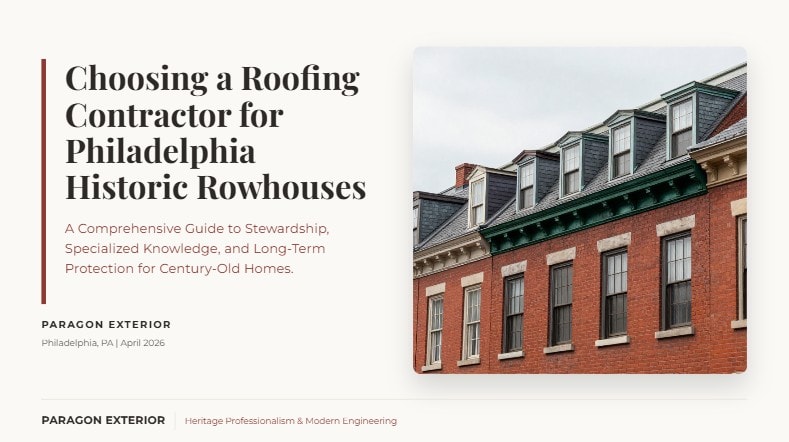
Why Philadelphia Rowhouses Require a Different Contractor Evaluation
The Philadelphia rowhouse presents roofing challenges that contractors without specific local experience consistently underestimate. Understanding why changes how you evaluate every contractor on your shortlist.
Construction history depth. Philadelphia’s housing stock is older than that of most American cities. The American Community Survey data cited in the City of Philadelphia’s official Philadelphia Rowhouse Manual puts the median rowhouse age at 93 years, meaning half of Philadelphia’s attached homes were built before 1933. Roofs on these homes carry decades of layered repair history: original slate over board sheathing, an asphalt overlay applied sometime in the 1970s, and sometimes a second overlay applied in the 1990s. A contractor who does not inspect what is beneath the visible surface installs a new system on a compromised foundation.
Party wall complexity. Rowhouses share walls with adjacent properties. Flashing that terminates incorrectly at a party wall allows water to migrate laterally into a neighbor’s structure. This is a liability and a relationship problem simultaneously. A contractor unfamiliar with attached housing construction treats the party wall termination the same as a standard exterior wall, and the callback arrives within 18 months.
Philadelphia Historical Commission jurisdiction. A significant portion of Philadelphia’s rowhouse stock sits in designated historic districts. Work in these areas requires material approval from the Philadelphia Historical Commission before L&I will issue a permit. Contractors who have not navigated PHC approval before will discover the requirement after materials are ordered and the crew is scheduled, creating delays and potential material substitutions that may not meet historic preservation standards.
Permit requirements are not optional. Philadelphia’s Department of Licenses and Inspections requires a permit for roof replacement. The permit fee averages $232 based on 2026 National Roofing Price Index data for Philadelphia. Any contractor who suggests skipping the permit is operating outside legal requirements, and any roof installed without a permit creates disclosure obligations at resale and, in most cases, voids manufacturer warranty coverage.
The Paragon Pre-Installation Assessment Protocol
With over 10 years of experience replacing roofs on Philadelphia’s historic housing stock, Paragon Exterior has developed and refined a seven-step assessment protocol applied before any installation begins. We call it the Paragon Pre-Installation Assessment Protocol. Every legitimate Philadelphia roofing contractor for historic properties should follow a comparable structure. If a contractor’s process does not include all seven steps, the steps they skip are where failures occur.
Step 1: Pre-Visit Records Review
Before arriving at the property, a thorough contractor reviews the permit history in Philadelphia’s L&I public records, determines whether the property is in a designated historic district subject to Philadelphia Historical Commission review, and notes the home’s approximate construction era. This takes 20 minutes and prevents surprises at the permit application that delay the project by weeks.
Step 2: Surface and System Inspection
The on-roof inspection covers the visible membrane or shingle condition, all flashing points (chimney, dormers, skylights, party walls, rake edges, valleys, and any pipe penetrations), ridge and valley condition, and drainage configuration. Every failure point visible from the roof surface is photographed and documented before any estimate is presented.
Step 3: Attic and Structural Assessment
This is the step where most contractors fail with Philadelphia rowhouse homeowners. The attic assessment covers ventilation adequacy (soffit-to-ridge airflow calculation), moisture staining on rafters consistent with past or current water intrusion, soft spots in decking boards at valleys and on north-facing roof sections where ice damming is concentrated, and the condition of the insulation. As Maxwell Martin, CEO of Paragon Exterior, has stated in published documentation of this process: “Attic inspection is never optional on a historic Philadelphia home. The visible surface tells you what failed. The attic tells you why.”
Step 4: Hidden Layer Discovery
When the attic and surface inspection indicate substrate compromise, full tear-off to bare rafters is required before any material is installed. Installing new materials over compromised decking turns a 15-year roof into a 7-year roof, regardless of the quality of the new membrane or shingle system. This step requires the contractor to be honest with the homeowner about what the tear-off will reveal, and to stop work for homeowner authorization if unexpected conditions are found during the tear-off. No scope expansion proceeds without written homeowner authorization.
Step 5: Climate-Specific Material Selection
Philadelphia’s climate creates specific performance requirements that generic national roofing specs do not address. The city averages 100 freeze-thaw cycles per year, 43 inches of annual precipitation, and significant Nor’easter wind uplift events. Architectural asphalt shingles rated for 130 mph wind gusts outperform 3-tab shingles in Philadelphia’s specific storm pattern. Ice and water shield extended to five feet from each eave on north-facing sections, rather than the standard four feet, addresses the ice-damming pattern that concentrates at north-facing valleys. Material selection is not one-size-fits-all, and the recommendation should account for the property’s orientation, slope, and exposure conditions.
Step 6: Permit and Compliance Mapping
Every Philadelphia roof replacement requires an L&I permit. Historic district properties additionally require Philadelphia Historical Commission review before L&I will issue. HOA-governed properties in attached communities require HOA approval of the contractor, materials, and color before work begins. A contractor who handles permit and compliance mapping as part of their standard process is the right choice for a historic rowhouse in Philadelphia. A contractor who tells you the permit is your responsibility is not.
Step 7: Written Scope and Warranty Documentation
The written estimate itemizes materials (manufacturer name, product line, grade, and warranty name), labor, tear-off method, permit fees, debris disposal, and deck inspection findings. Warranty terms are stated as a named warranty from a specific manufacturer, covering materials and workmanship separately for specific durations. Nothing is presented verbally or as a lump sum. The documentation produced at this step serves as the homeowner’s protection if the relationship with the contractor deteriorates after the contract is signed.
What the Paragon Pre-Installation Assessment Found on a 130-Year-Old Langhorne Victorian
This case study illustrates exactly why Steps 3 (Attic and Structural Assessment) and 4 (Hidden Layer Discovery) are non-negotiable for older Philadelphia-area housing stock.
The project began as a routine request: replace the roof on a late-Victorian two-story built in the early 1890s in Langhorne Borough, Bucks County. The home had been in the family for two generations. The owners knew they needed new shingles. The surface inspection revealed a mid-1970s asphalt overlay installed over original Victorian-era slate, which was itself applied over original wooden board sheathing. The slate was largely intact, but the asphalt overlay had been trapping moisture and slowly rotting the boards beneath for decades.
The attic inspection found inadequate ventilation, with visible moisture staining on rafters consistent with decades of cycling, and three distinct soft-decking areas near north-facing valleys where a misaligned valley-flashing overlay installed during the 1970s had been pooling water against the substrate for 50 years. The original Victorian lead chimney flashing had been patched multiple times and was failing at the base.
The solution required full tear-off to bare rafters, 12 sheets of OSB replacement at the three valley sections and the north ridge, extended ice and water shield coverage given the north-facing exposure, complete lead-coated copper chimney reflashing appropriate to the historic character of the home, and two additional ridge vents with soffit baffle replacement to address the ventilation deficit the attic assessment had identified.
The completed ventilation improvements extended the expected life of the new roof system by an estimated 3 to 5 years over what a deficient system would have allowed. The chimney reflashing eliminated an interior moisture problem that had been slowly damaging plaster on the east wall of the home. Neither outcome was visible from a surface inspection. Both were documented in writing before work began. The homeowners noted in their published review that no nails were found in the landscaping after the project was completed.
A contractor who skips the attic inspection on this home installs a new roof on a substrate that was still rotting from below. The new system fails in 7 years instead of 20; the homeowners call again, and the pattern repeats.
How Manufacturer Certification Levels Affect Your Philadelphia Roof
GAF, the largest residential roofing manufacturer in North America, operates a contractor certification program with multiple tiers. The tier matters because it determines which warranty protection is available to you after installation is complete.
At the standard certification tier, a contractor can offer GAF’s System Plus Limited Warranty, which covers manufacturing defects in GAF products. The workmanship coverage at this tier is the contractor’s own warranty, backed only by the contractor’s continued business operation.
At the highest certification tier, which requires verified insurance minimums, a demonstrated installation track record, and ongoing compliance with factory training, as independently reviewed by GAF, a contractor can offer the GAF Golden Pledge warranty. The Golden Pledge provides up to 50 years of material coverage and up to 25 years of workmanship coverage backed by GAF as a manufacturer rather than solely by the contractor. For a Philadelphia historic rowhouse with a replacement cycle of 20 to 30 years, the workmanship warranty backstop matters: if the contractor’s business changes in year 7, the warranty coverage through GAF remains intact.
Paragon Exterior is a GAF-certified roofing contractor whose certification activates the Golden Pledge warranty option on qualifying installations. This is the warranty Paragon offers Philadelphia homeowners for complete GAF system installations, and it is the most appropriate protection for a historic rowhouse where the next roof decision is a generation away.
Red Flags: What to Watch for When Evaluating Philadelphia Roofing Contractors
These specific behaviors distinguish a contractor who is building a long-term Philadelphia business from one who will not answer the phone in three years.
Lump-sum estimates without material specification. Any estimate that presents a single total without naming the shingle manufacturer, product line, grade, and warranty is incomplete. You cannot accurately compare contractors on price alone if you do not know what each contractor is pricing.
No permit mentioned. Every Philadelphia roof replacement requires an L&I permit. A contractor who does not mention the permit in the estimate is either unaware of the requirement or planning to skip it. Either situation disqualifies them.
Verbal estimates only. A contractor who gives you a price over the phone without inspecting the property has not assessed your specific conditions. Whatever number they give you will change after the tear-off begins, because they have not accounted for what they cannot see.
Same-day signing pressure. Reputable contractors understand that homeowners need time to compare estimates. Any contractor who tells you the price is only valid today or who demands a deposit before you have reviewed the written estimate in full is exhibiting a behavior pattern documented in BBB complaints against contractors who subsequently become difficult to reach.
Storm-chasers after Nor’easters. Following every significant storm event in Philadelphia, out-of-market contractors arrive in neighborhoods and knock on doors, offering “free roof inspections” before homeowners have had time to assess the situation. These contractors typically ask homeowners to sign a “direction to pay” document before any inspection is done, transferring insurance proceeds to the contractor before a claim is even filed. A legitimate contractor inspects first and asks for nothing until an estimate is reviewed and accepted.
Requests for full payment up front. Standard roofing contracts in Philadelphia request a deposit of 10 to 30 percent to order materials, with the balance due upon completion and homeowner walkthrough. Any contractor asking for 50 percent or full payment before work begins is operating outside standard practice.
Subcontractor-only crews. A contractor whose installation crews are subcontractors has no direct accountability over the workers on your roof. Factory certification that covers the contractor does not automatically extend to subcontractors. Paragon Exterior uses trained, dedicated in-house crews for every installation, a requirement for maintaining GAF certification.
What a Legitimate Philadelphia Roofing Estimate Looks Like
A written estimate from a qualified Philadelphia roofing contractor for a historic rowhouse should contain the following line items, all specified in writing:
Materials: manufacturer name, product line (e.g., GAF Timberline HDZ), color selection, warranty name (e.g., GAF Golden Pledge), and the specific coverage duration for both materials and workmanship.
Tear-off method: whether the existing layers are being removed completely (correct for any Philadelphia historic home) or whether the new system is being installed over existing material (not recommended on homes over 20 years old or with multiple existing layers).
Deck inspection: a statement of the contractor’s process if substrate damage is found during tear-off, including the authorization step before any additional scope proceeds and the per-square-foot cost for deck repair if needed.
Permit fees: a specific dollar amount or range for the L&I permit, pulled and closed by the contractor as part of the standard scope.
Debris disposal: the method (Equipter, dumpster, or manual) and confirmation that a magnetic sweep of the property is included in the cleanup.
Historic district notation: if the property is in a PHC-designated district, a statement of how the contractor handles the PHC approval process and the timeline implications.
Timeline: start date, projected duration, and what happens if weather delays the schedule or if deck damage extends the scope.
Payment terms: deposit amount, conditions for the final payment, and confirmation that the final payment is not due until the homeowner walkthrough is complete.
Philadelphia-Specific Cost Context for 2026
Philadelphia roof replacement cost data published in April 2026 by InstantRoofer, based on current contractor pricing inputs and roof measurement data, shows the average cost to replace a roof in Philadelphia at $7,210, based on the city’s average roof size of approximately 1,016 square feet and the dominant material (architectural asphalt shingles at $7.10 per square foot installed).
Philadelphia contractor labor rates run $250 to $450 per roofing square (100 square feet), a meaningful premium above the $200 to $350 range in surrounding suburban counties. The premium reflects the complexity of row-home access, higher permit and disposal costs, and the logistics of working on densely packed urban blocks. For a 1,500-square-foot Philadelphia rowhouse with a pitched section and a flat rear addition, a full replacement of both surfaces with architectural shingles and modified bitumen, respectively, will typically run $11,000 to $18,000, depending on material grade, access conditions, and substrate findings after tear-off.
For historic district properties with chimney reflashing requirements, custom flashing materials appropriate to the architectural era, or PHC review timeline implications, add $1,500 to $4,000 to the base estimate, depending on chimney complexity and material specification.
Expert Commentary: Maxwell Martin, CEO, Paragon Exterior
The following commentary is drawn from Maxwell Martin’s published documentation of the inspection and installation process from Paragon Exterior’s completed project records.
What is the single most important question a Philadelphia homeowner should ask a roofing contractor?
The most important question is simple: “Will you inspect the attic before giving me an estimate?” A contractor who says no is telling you they are pricing the job based on what they can see from the roof surface. On a Philadelphia rowhouse that is 50, 80, or 130 years old, the surface is almost never the whole story. The attic tells you what the surface is hiding. We have inspected homes where the surface shingles had another five years of visible life, but the attic showed moisture staining on every rafter and on the soft decking in three valley sections. If we had priced from the surface, we would have installed over a substrate that was already failing.
What makes the Paragon Pre-Installation Assessment Protocol different from a standard inspection?
The difference is that our assessment protocol treats the attic and the structural substrate as required inspection areas, not as optional add-ons if we happen to notice a problem. Most contractors inspect the surface, write the estimate, show up on day one, and then call the homeowner from the roof to say there is decking damage and the price is going up. We inspect the attic and document the decking condition before the estimate is written. The homeowner knows the full picture before they sign anything. That is the commitment the Paragon Mission is built around: no surprises.
How do you handle Philadelphia Historical Commission requirements?
We have handled PHC review on a number of historic district projects in Philadelphia and the surrounding communities. The key is starting early. PHC review adds time to the project timeline if you begin the material approval process after the estimate is accepted. We build the PHC process into our pre-permit step, which means we identify whether the property is in a designated district during Step 1 of our protocol, before anything else. For most residential projects, the PHC staff review is completed at the staff level without a full commission hearing, which typically takes three to four weeks. Modern materials, such as GAF Timberline architectural shingles in appropriate colors, are regularly approved in Philadelphia historic districts.
What is the most common hidden condition you find during the attic assessment on Philadelphia rowhouses?
Inadequate ventilation is the most consistent finding. Philadelphia rowhouses were not designed with modern ridge-to-soffit ventilation standards in mind. The original slate roofs breathed differently than modern asphalt systems. When an asphalt overlay was installed in the 1970s or 1980s without upgrading the ventilation system, the attic began trapping moisture that the original slate construction had been managing through natural airflow. That trapped moisture cycles through the substrate for decades. The rafters stain. The decking softens at the valleys where moisture concentrates. By the time the third roof system needs replacement, the decking condition in a north-facing valley can be so severe that a structural assessment is required before new material is installed. Ventilation correction at the time of replacement extends the life of the new roof system by 3 to 5 years, based on our observed outcomes from comparable Philadelphia properties.
How do you protect homeowners from costs that were not in the original estimate?
We protect them the same way in every project: we stop work, document what we found with photographs, call the homeowner from the roof, explain what we found and what it requires, and present a written addendum with the cost of the additional scope before any additional work begins. Nothing proceeds without written authorization. The homeowner is never presented with a surprise bill at project completion. If the additional work is extensive enough that the homeowner needs time to evaluate, we install temporary protection and wait. The Paragon Mission starts with complete communication, and that means no scope expansion without explicit homeowner authorization, every time.
The Multi-Unit Rowhouse Consideration: What the Richboro Village Shires Case Taught Us
In attached communities where multiple units share a connected roofline, the contractor selection decision has implications that extend beyond the unit that initiates contact. This case illustrates why.
Paragon Exterior was initially contacted by a single Village Shires homeowner in Richboro, Bucks County, regarding water staining on her dining room ceiling. The stain had grown each winter for three years and receded each summer, leading her to believe the problem was intermittent. A previous patch repair from another contractor had held for one season before the staining returned.
The inspection revealed the primary leak source: the original 1982 valley metal, corroded through at one point, with a 2000 overlay installed over it rather than replacing the valley. But the inspection of the connected building section found that Unit 2, which had reported no leaks, had a failing ridge cap with moisture staining on the underlying ridge board consistent with two to three seasons of intrusion. Unit 3 had a dormer flashing failure, which the homeowner attributed to a plumbing problem. Unit 4 had rake-edge decking damage that had not yet produced interior symptoms.
The correct solution required HOA approval, Northampton Township permitting for the entire connected section, and a coordinated four-unit installation. Three homeowners had active symptoms. One had developing conditions that would have produced interior damage within another winter season. A contractor who inspected only the single unit that was called would have repaired that unit and left three units with undiagnosed conditions.
For Philadelphia homeowners in twin homes, pairs of attached rowhouses, or any property with a connected roofline, the building-section inspection rather than the single-unit inspection is the correct starting point for any roofing decision.
GAF Certified · 4.9 Stars / 100+ Reviews · Free Inspection Within 24-48 HoursCall (215) 799-7663 — Questions Welcome | Request Online
Frequently Asked Questions: Choosing a Roofing Contractor in Philadelphia
How do I verify a roofing contractor is legally registered in Pennsylvania?
Search the contractor’s name or HIC number at the Pennsylvania Attorney General’s Home Improvement Contractor registry. Pennsylvania requires all home improvement contractors to register under the Home Improvement Consumer Protection Act before accepting work. Paragon Exterior holds PA HIC License #PA197973. Any contractor who cannot produce their HIC number on request is operating outside legal requirements, which also affects their ability to pull valid permits.
What is the difference between GAF Certified and the highest GAF certification tier?
GAF’s certified tier allows contractors to offer the System Plus Limited Warranty, which covers manufacturing defects in GAF materials. The highest certification tier, which requires verified insurance minimums, a demonstrated track record, and compliance with factory training, reviewed independently by GAF, unlocks the GAF Golden Pledge warranty: up to 50 years of material coverage and up to 25 years of workmanship coverage, backed by GAF as the manufacturer. Paragon Exterior’s GAF certification activates the Golden Pledge option on qualifying installations. For a Philadelphia historic rowhouse with a 20-to-30-year replacement cycle ahead, the manufacturer-backed workmanship warranty is the relevant differentiator.
How much does roof replacement cost for a Philadelphia historic rowhouse in 2026?
Philadelphia roof replacement averages $7,210 based on InstantRoofer’s April 2026 data for the city, based on an average roof size of approximately 1,016 square feet. For a historic rowhouse with both a pitched main section and a flat rear addition, a full replacement of both surfaces typically runs $11,000 to $18,000, depending on material grade, access conditions, and substrate findings. Add $1,500 to $4,000 for historic district properties requiring chimney reflashing with period-appropriate materials or PHC review timeline management.
Does a Philadelphia roofing contractor need a separate permit for historic district properties?
Properties in Philadelphia Historical Commission-designated districts require PHC material approval before L&I will issue a building permit for roofing work. The PHC approval process typically concludes at the staff review level without a full commission hearing and takes three to four weeks. Paragon Exterior manages the PHC process as part of the standard project scope on historic district projects.
What should a roofing estimate for a Philadelphia historic rowhouse include?
A complete estimate itemizes: material manufacturer and product line with warranty name and coverage duration, tear-off method, deck inspection process, and per-square-foot repair cost if needed, permit fees as a line item, debris disposal method, historic district notation if applicable, project timeline with weather contingency, and payment terms with final payment contingent on homeowner walkthrough.
How do I know if a Philadelphia roofing contractor will be in business when I need warranty work?
The most reliable indicator is a manufacturer-backed workmanship warranty. When the warranty is backed by GAF as a manufacturer rather than solely by the contractor, the coverage survives any change in the contractor’s business. Paragon Exterior’s GAF certification activates this option. Beyond warranty structure, a contractor with a verified physical address, documented Pennsylvania HIC registration, active GAF profile, and BBB profile has more accountability than an unlisted contractor with only a website and a phone number.
What is the Paragon Pre-Installation Assessment Protocol?
The Paragon Pre-Installation Assessment Protocol is a seven-step inspection process that Paragon Exterior applies to every roofing project in Philadelphia before any estimate is prepared. The steps are: (1) pre-visit records review, (2) surface and system inspection, (3) attic and structural assessment, (4) hidden layer discovery, (5) climate-specific material selection, (6) permit and compliance mapping, and (7) written scope and warranty documentation. The protocol addresses the specific inspection requirements of Philadelphia’s historic housing stock, including attic ventilation, substrate condition under layered repair history, party wall flashing, and historical commission compliance.
How long does roof replacement take on a Philadelphia historic rowhouse?
A standard replacement on a Philadelphia rowhouse with a single-pitched section and a rear flat addition typically completes in two to three days. Projects involving chimney reflashing, ventilation upgrades, significant decking replacement, or historic district material coordination may extend to three to four days. Paragon Exterior’s Langhorne Victorian project, which included 12 sheets of decking replacement, lead-coated copper chimney reflashing, and ventilation system upgrades, was completed in three days with no overnight weather exposure of the open substrate.
What happens if a contractor finds deck damage after the tear-off begins?
Work stops, the damage is photographed, the homeowner is contacted before any additional scope begins, and a written addendum with the cost of the additional work is presented for authorization. Nothing proceeds without the homeowner’s written approval. This is the Hidden Layer Discovery step of the Paragon Pre-Installation Assessment Protocol in the application. Deck repair costs $2 to $7 per square foot of damaged area, based on Angi 2026 data, and must be addressed before installing any new membrane or shingle system to prevent early failure from substrate deterioration.
Why do attic inspections matter specifically for Philadelphia rowhouses?
Philadelphia rowhouses were not designed with modern ridge-to-soffit ventilation standards. When asphalt overlays were installed in the 1970s and 1980s over original slate systems, the attic ventilation was rarely upgraded to match the changed airflow requirements. The trapped moisture cycles through the substrate for decades, softening decking in north-facing valleys and consistently staining rafters. By the time the home needs its third roof replacement, the attic moisture history is visible in the substrate’s structural condition — but only if someone looks. Maxwell Martin, CEO of Paragon Exterior, notes that inadequate ventilation is the most consistent finding on attic inspections of Philadelphia rowhouses built before 1950.
Should I get multiple estimates for a roof replacement in Philadelphia?
Yes, and the estimates are only meaningfully comparable if each one itemizes the same information: material brand and product line, tear-off method, permit handling, deck inspection protocol, and warranty terms by name. An estimate listing the material as “architectural shingles” without specifying the manufacturer or warranty cannot be accurately compared to an estimate specifying GAF Timberline HDZ with the Golden Pledge warranty. The price difference between those two estimates means something completely different from what it appears on the surface.
What is the Philadelphia Rowhouse Manual, and why does it matter for roofing decisions?
The Philadelphia Rowhouse Manual, published by the City of Philadelphia in 2008, is the authoritative guide to maintaining and renovating Philadelphia’s attached housing stock. It covers roofing materials, water management, historic district requirements, and structural considerations specific to rowhouse construction. It is the reference document that distinguishes contractors who understand Philadelphia’s housing stock from those who apply suburban roofing logic to urban attached homes. Paragon Exterior’s inspection protocol and material selection recommendations are consistent with the standards that the Philadelphia Rowhouse Manual establishes.
How do storm chaser contractors operate in Philadelphia after Nor’easters?
Storm chaser contractors, typically based outside the region, arrive in Philadelphia neighborhoods within 24 to 72 hours of a major storm event. Their operating pattern is consistent: door-to-door canvassing with an offer of a “free inspection,” immediate pressure to sign a “direction to pay” document that transfers insurance proceeds to the contractor before any claim is approved, and requests for a deposit before the estimate is reviewed. A legitimate local contractor inspects the property, documents the damage in the format required by insurance adjusters, provides a written estimate, and waits for the homeowner to review it before accepting any payment.
Does homeowners’ insurance cover a roof replacement in Philadelphia after storm damage?
Homeowners insurance covers roof replacement when the damage was caused by a sudden covered peril: wind, hail, ice, a falling tree, or storm-related impact. It does not cover age-related deterioration, deferred maintenance, or manufacturer defects. After a major storm in Philadelphia, the insurance claim process involves documenting damage with photos before any repairs begin, filing promptly within the policy’s claims window, and having a licensed contractor provide documentation in the format required by the adjuster. Paragon Exterior assists homeowners with damage documentation and communication with adjusters at no additional charge for qualifying storm-damage projects.
What is the difference between actual cash value and replacement cost value for roof insurance claims?
An actual cash value (ACV) insurance policy pays the depreciated value of the roof at the time of loss, meaning the payout decreases as the roof ages and never covers the full replacement cost. A replacement cost value (RCV) policy covers the full cost to replace the damaged roof with comparable materials, minus the deductible. Philadelphia homeowners with older roofs should review their policy type before storm season. An ACV payout on a 20-year-old roof may cover only 30 to 40 percent of the actual replacement cost. Understanding this before filing prevents surprises during the claims process.
How do freeze-thaw cycles specifically damage Philadelphia rowhouse roofs?
Philadelphia averages approximately 100 freeze-thaw cycles per year. Each cycle stresses every sealed joint in the roofing system: shingle sealant strips, flashing terminations at chimney bases and party walls, ridge cap adhesive, and valley metal sealant. A joint that is 90 percent adhered survives many cycles before failing. A joint that is 70 percent adhered typically fails within three to five winter seasons. The cumulative effect on a poorly installed roof in Philadelphia is measurably faster than the same system in a climate with fewer annual freeze-thaw cycles, which is why installation quality at the detail points matters more in Philadelphia than manufacturer shingle quality alone.
What is the Roof Lifespan Calculator on the Paragon Exterior website?
The Paragon Exterior Roof Lifespan Calculator at paragonexterior.com/roof-lifespan-calculator estimates the remaining service life of an existing roof based on inputs including roof age, material type, visible condition indicators, and maintenance history. It is a free tool designed to help Philadelphia homeowners assess whether their roof is approaching a decision point before a contractor is called. Using the calculator before scheduling an inspection allows homeowners to approach the estimate conversation with a baseline expectation of what they may face.
Can a Philadelphia roofing contractor handle a replacement on a twin home or semi-detached property?
Yes, but the shared roofline creates coordination requirements that a single-family replacement does not. The connecting ridge section spans both properties. Any work on the shared ridge requires coordination with the adjacent neighbor, and in some configurations, their participation in the permit process. Paragon Exterior has experience managing twin-home and semi-detached replacement projects, including HOA-coordinated multi-unit installations where the permit, material specifications, and schedule span multiple ownership units.
What neighborhoods in Philadelphia does Paragon Exterior serve for historic rowhouse roofing?
Paragon Exterior serves all of Philadelphia’s historic rowhouse neighborhoods, including South Philadelphia, West Philadelphia, North Philadelphia, Fishtown, Kensington, Manayunk, Germantown, Chestnut Hill, Queen Village, Passyunk Square, Graduate Hospital, and Center City. Paragon also serves Bucks County communities, including Langhorne, Richboro, Newtown, and Doylestown, as well as the greater Philadelphia suburbs in Montgomery, Delaware, and Chester Counties, and South Jersey. Call (215) 799-7663 to confirm service availability at a specific address.
How do I schedule a free roof inspection with Paragon Exterior?
Call (215) 799-7663 or request an inspection online at paragonexterior.com/estimate. Most Philadelphia homeowners are scheduled within 24 to 48 hours. The inspection is free, the written estimate is delivered before any commitment is required, and the Paragon Pre-Installation Assessment Protocol applies to every job regardless of size. If you have an active leak, storm damage, or a situation requiring urgent attention, mention it when you call, and Paragon will prioritize accordingly.
About the Author
Maxwell Martin, CEO, Paragon Exterior LLC
Maxwell Martin has 20+ years of hands-on experience in the exterior remodeling industry, specializing in residential and historic roofing across Philadelphia, Bucks County, and the greater Delaware Valley. Paragon Exterior holds PA License #PA197973, GAF certification with access to the Golden Pledge warranty, and a 4.9-star rating across 100+ verified Google reviews. Paragon serves Greater Philadelphia, Bucks County, Montgomery County, Delaware County, NJ, and DE. All inspection and installation work follows the Paragon Pre-Installation Assessment Protocol documented in Paragon Exterior’s published case studies.
GAF Contractor Profile | BBB Profile | BuildZoom Profile (Score: 94)
