
Repair vs. Replace a Philadelphia Asphalt Roof After Storm Damage or Aging Shingles
The repair-or-replace question is the most common source of contractor disagreement in Philadelphia roofing. Two contractors inspect the same roof and one recommends repair; the other recommends replacement. Both may be giving technically honest answers, or one may be recommending the larger job regardless of whether it is warranted. Choosing a roofing contractor Philadelphia 2026 for either scope requires understanding the five factors that objectively determine which answer is correct, so you can evaluate any recommendation against documented findings.
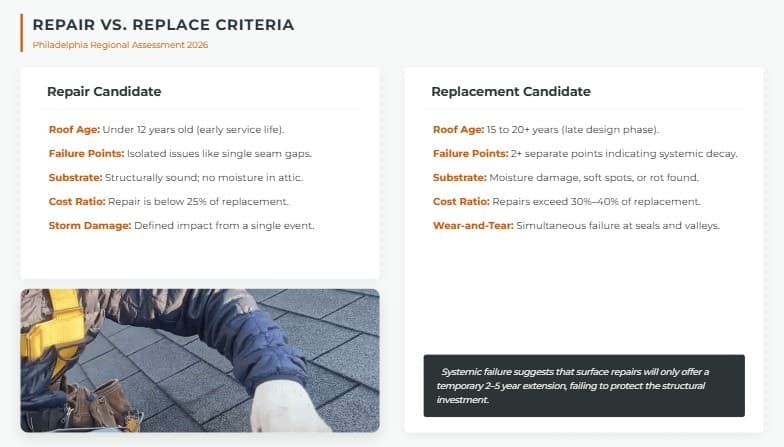
The 5-Factor Decision Framework
Factor 1: Roof Age Relative to Design Life
Architectural asphalt shingles have a design life of 25 to 35 years. A roof under 12 years old is early in its service life and a candidate for repair of isolated failures. A roof at 15 to 20 years has typically experienced 1,500 to 2,000 freeze-thaw cycles in Philadelphia’s climate and is in the late phase of its design life. Repairs on a 17-year-old Philadelphia rowhouse roof address the visible failure point but do not change the underlying state of the system, which is approaching the end of life at every seal, sealant termination, and valley detail simultaneously.
Factor 2: Number of Identified Failure Points
An isolated seam gap, a single lifted flashing termination, or a localized hail impact pattern on a roof with otherwise intact surface is a repair candidate. Two or more separate failure points in a roof that are not the result of a single storm event indicate systemic adhesion degradation: the system is failing at multiple points simultaneously, not due to a single installation error. The National Roofing Contractors Association’s technical resources documentation notes that multiple simultaneous failure points in the same system are a reliable indicator of end-of-effective-service life regardless of apparent surface condition between the failure points.
Factor 3: Substrate Condition
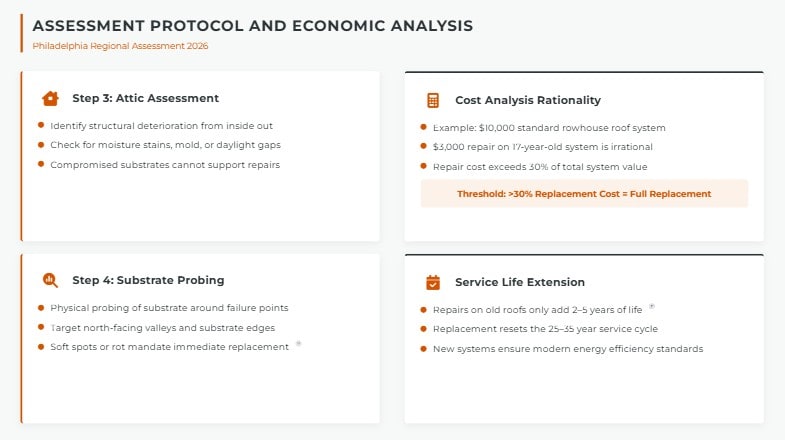
This is the determining factor in the Hidden Layer Discovery step of the Paragon Pre-Installation Assessment Protocol. A substrate showing soft spots on probing, visible moisture staining along exposed substrate edges, or structural deterioration in north-facing valley sections cannot support a repair expected to materially extend service life. Installing a repair over a damaged substrate results in failure at the repair perimeter within 2 to 5 years, as the substrate continues to deteriorate. If substrate damage is found, the replacement question is answered regardless of roof age or failure count.
Factor 4: The 30 to 40 Percent Cost Threshold
Repair becomes economically irrational when its cost approaches 30 to 40 percent of the cost of a full replacement for the same roof. For a standard Philadelphia rowhouse pitched section with a replacement cost of $8,000 to $12,000, a repair estimate of $2,400 to $4,800 triggers the cost-threshold evaluation. The relevant question is not whether the repair is technically possible. It is whether the repair extends the service life enough to justify the cost relative to a full replacement that resets the 25-to-35-year cycle to year one. A repair on a 17-year-old roof extends the next replacement to year 20 or 22. A full replacement at year 17 extends the next replacement to years 47-52.
Factor 5: Storm Damage vs. Wear-and-Tear Presentation
When the failure was caused by a specific storm event (Nor’easter wind uplift, hail impact, falling tree), the repair scope is defined by the extent of storm-caused damage. A legitimate repair addresses that specific damage. If the storm event also revealed pre-existing conditions contributing to the damage (e.g., inadequate flashing that a wind event exposed rather than caused), those conditions should be addressed in the repair scope or documented as a recommendation for full replacement within a defined timeline.
What the Paragon Protocol Finds on Repair Candidates
Paragon Exterior’s Paragon Pre-Installation Assessment Protocol applies the same seven-step inspection to repair candidates as to replacement candidates. The attic assessment step (Step 3) and the hidden layer discovery step (Step 4 in the repair context: probing and visual assessment of the substrate around the failure point) produce the substrate condition finding, which often determines the recommendation.
Maxwell Martin’s documented observation from Paragon’s Philadelphia repair inspection experience: “The repair calls we take most seriously are the ones where the homeowner has had the same area patched before. One patch repair that held for a season and then failed is a system telling you something. Two patch repairs at the same location that failed within 18 months of each other are a substrate problem, not a surface problem. The surface repair is not the answer.”
When Paragon Recommends Repair
A roof under 12 years old with a single active failure point, a structurally sound substrate confirmed by the attic assessment, and a repair cost below 25 percent of replacement cost is a repair recommendation. Paragon Exterior’s written repair scope itemizes the specific failure, the repair method, the materials used, and the expected service extension. The written estimate for a repair is as specific as that for a full replacement, because the homeowner’s ability to evaluate the recommendation depends on knowing what they are buying.
When Paragon Recommends Replacement
A roof 15 or more years old with two or more identified failure points, any substrate moisture finding during the attic inspection, or a repair cost at or above 30 percent of replacement cost is a replacement recommendation. The replacement recommendation from Paragon Exterior is delivered with the same inspection documentation, photographs, and written finding summary as the repair recommendation—the homeowner receives the evidence basis for the recommendation, not just the recommendation itself. This is the Written Scope and Warranty Documentation step of the Paragon Pre-Installation Assessment Protocol, applied at the assessment rather than at the contract.
Attic Inspection Included · Written Finding Summary · Honest RecommendationCall (215) 799-7663 | Request Online
FAQs: Repair vs. Replace Philadelphia Roof
How much does a targeted roof repair cost in Philadelphia?
Single-point roof repairs in Philadelphia run $400 to $1,500, depending on the failure type and extent: valley repair $400 to $700; flashing repair $500 to $900; localized shingle replacement $300 to $600; ridge cap repair $400 to $700. When repair costs approach $2,400 to $4,800 for a roof that is 15 or more years old, the 30 to 40 percent threshold evaluation applies.
What finding during the inspection determines whether to repair or replace?
Substrate condition is the determining factor. Soft spots on probing, visible moisture staining at substrate edges, or structural deterioration around failure points indicate that repair will not address the underlying condition producing the failure. Substrate compromise is not addressed by surface repair, regardless of the patch material’s quality.
Should I get the same area repaired again if a previous repair failed?
One failed patch repair at the same location warrants a full inspection to determine whether the failure is a surface or substrate issue. Two failed patch repairs in the same location within 18 months is almost always a substrate problem. Additional patching at the same location, without a substrate assessment, is not a repair recommendation supported by Paragon Exterior.
How do I schedule a free repair vs. replacement assessment with Paragon Exterior?
Call (215) 799-7663 or visit paragonexterior.com/estimate. Free inspection includes an attic assessment, a substrate condition evaluation, and a written finding summary with the documented basis for the repair or replacement recommendation. Scheduled within 24 to 48 hours.
GAF Profile | BBB Profile | BuildZoom
