
How to Get Homeowners Insurance to Pay for Roof Replacement in Philadelphia After Storm Damage
Philadelphia’s Nor’easters and summer thunderstorms cause roof damage that qualifies for coverage under most standard homeowners’ insurance policies. The challenge is that many Philadelphia homeowners either file incorrectly or too late, or are rushed into signing contractor agreements by post-storm contractors before their claim is even approved. Choosing a roofing contractor Philadelphia 2026 for an insurance claim situation requires understanding how the insurance process works so that the contractor you hire is helping you navigate it correctly, not taking advantage of your confusion about it.
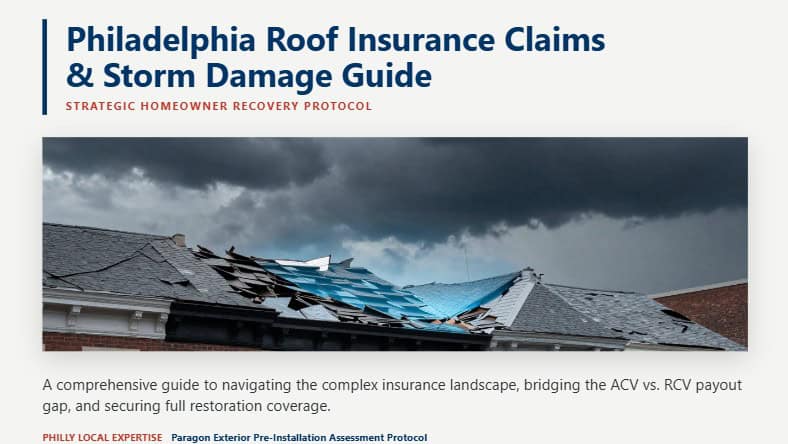
What Philadelphia Storm Damage Homeowners Insurance Covers
Homeowners insurance covers roof damage caused by sudden, covered perils: wind, hail, ice, falling trees, and storm-driven water intrusion through a newly created breach. It does not cover age-related deterioration, deferred maintenance, or wear and tear. The distinction matters because Philadelphia’s older housing stock often exhibits a combination of preexisting age-related wear and new storm damage, and insurers will attempt to separate what is covered from what is not.
Philadelphia experiences roof claim events from three primary storm types: Nor’easters (wind uplift on shingles and flashing), summer thunderstorms (hail and wind), and occasional tropical storm remnants (water volume and wind combination). After Hurricane Ida’s remnants moved through the Delaware Valley in 2021, roof damage claims in Philadelphia were significantly elevated for multiple seasons following.
ACV vs. RCV: The Policy Distinction That Determines Your Payout
The most consequential insurance term for Philadelphia roofing claims is the distinction between Actual Cash Value (ACV) and Replacement Cost Value (RCV) coverage.
An ACV policy pays the depreciated value of the damaged roof at the time of loss. A 20-year-old asphalt shingle roof with a 30-year expected lifespan has approximately 33% of its remaining life. An ACV policy on this roof might pay 33 percent of the replacement cost, leaving the homeowner responsible for the remaining 67 percent out of pocket. On a $14,000 Philadelphia rowhouse roof replacement, the ACV payout might be $4,600, with the homeowner covering the $9,400 difference.
An RCV policy covers the full cost to replace the damaged roof with comparable materials, minus the deductible. On the same $14,000 replacement with a $1,500 deductible, the RCV payout is $12,500. The difference between ACV and RCV coverage on an older Philadelphia roof can be $8,000 to $10,000 on a standard replacement project.
Philadelphia homeowners should review their policy declarations page before the next storm season to confirm which type of coverage they hold. Switching from ACV to RCV coverage is possible at renewal and incurs a relatively small premium increase compared to the difference in claim payouts for an older home.
The Documentation Steps That Protect Your Claim
Insurance claims fail or are reduced most often due to inadequate documentation during the critical window: the period immediately after the storm and before any repair work begins. The steps below follow the Paragon Pre-Installation Assessment Protocol’s documentation approach, adapted for the insurance-claim context.
Step 1: Photograph everything before touching anything. Document the exterior damage visible from the ground (missing shingles, lifted flashing, debris), any interior damage (water stains on ceilings, wet insulation visible in the attic), and the condition of adjacent structures (gutters, fascia, siding). Date-stamp the photographs with the camera app or document the photo metadata. This is the evidence the adjuster will rely on to differentiate storm damage from pre-existing wear.
Step 2: Review your policy before filing. Confirm whether you have ACV or RCV coverage. Identify your deductible amount. Check the claims filing window: most Philadelphia homeowner policies require claims to be filed within 12 months of the damage event. Note any exclusions that might apply to your specific roof material or condition.
Step 3: Schedule a contractor inspection before the adjuster visit. A licensed roofing contractor can document damage in the format required by insurance adjusters, identify conditions that support coverage (storm-caused versus wear-related damage), and provide an itemized estimate that the adjuster can use as a reference. Paragon Exterior documents storm damage in the adjuster’s required format and provides this documentation as a standard part of any storm damage inspection. This is one of the services specified in the On-Site Inspection phase of the Paragon Pre-Installation Assessment Protocol for insurance situations.
Step 4: File the claim. Contact your insurer and provide your documentation. The insurer will either send an adjuster or ask you to obtain contractor estimates first. Do not delay filing: the longer you wait after storm damage, the harder it becomes to distinguish current storm damage from cumulative deterioration.
Step 5: Do not sign any contractor agreement before claim approval. Post-storm contractors frequently pressure homeowners to sign a “direction to pay” document that transfers insurance proceeds to the contractor before the claim is approved. Signing this document before claim approval gives the contractor access to your insurance payout regardless of whether their work meets your expectations. A legitimate contractor inspects, documents, provides an estimate, and waits for the homeowner to review the claim decision before accepting any payment authorization.
What Storm Chasers Do Differently After Philadelphia Nor’easters
Philadelphia neighborhoods receive visits from out-of-market contractors within 24 to 72 hours of every significant storm event. The behavior pattern is distinctive: door-to-door canvassing before homeowners have assessed their own situation, the offer of a “free inspection,” and immediate pressure to sign a “direction to pay” or “assignment of benefits” document. These contractors rely on post-storm urgency and homeowners’ unfamiliarity with the insurance process to secure commitments before homeowners have had time to evaluate options.
A legitimate local contractor operating in Philadelphia does not need to knock on doors after a storm. They have established clients, referral relationships, and a documented market history. Maxwell Martin’s guidance on storm-response contractors: “Any contractor who knocks on your door within 48 hours of a storm and asks you to sign something before you’ve filed your claim is not working in your interest. They are working in their. A legitimate inspection finds what is there and tells you about it. The paperwork comes after you’ve decided what you want to do with that information.”
Working with the Insurance Adjuster: The Contractor’s Role
The insurance adjuster has the final authority on claim approval and amount. The contractor’s role is to document the damage thoroughly, provide an accurate estimate in the format the adjuster requires, and be available to walk the adjuster through findings if the adjuster requests that. Paragon Exterior does not charge separately for adjuster documentation assistance on qualifying storm damage projects.
If the adjuster’s settlement offer seems low, the homeowner has the right to present contractor estimate documentation as the basis for a higher assessment. Adjusters can make errors, and supplemental evidence from a licensed contractor’s detailed inspection often produces a revised settlement. If the claim is denied, the homeowner has the right to appeal through the insurer’s appeal process.
Adjuster Documentation Included · No Pressure to Sign · Scheduled Within 24-48 HoursCall (215) 799-7663 — Questions Welcome | Request Online
Frequently Asked Questions: Insurance and Roof Replacement in Philadelphia
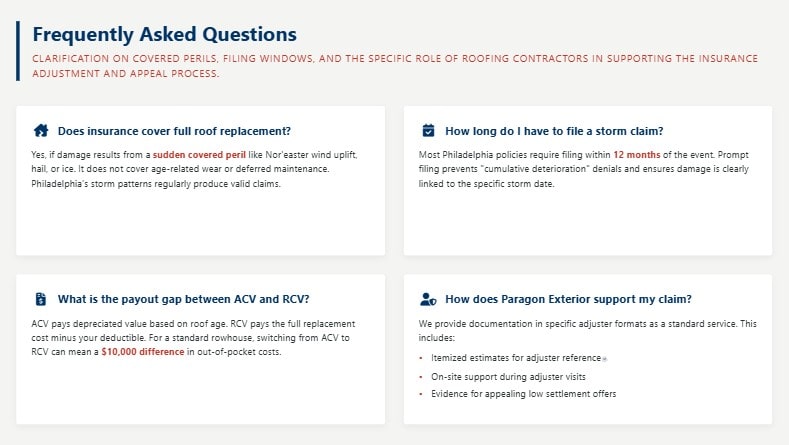
Does homeowners’ insurance cover roof replacement in Philadelphia?
Yes, when damage was caused by a sudden covered peril: Nor’easter wind uplift, hail, ice, or a falling tree. It does not cover age-related deterioration or deferred maintenance. Philadelphia’s storm patterns regularly produce legitimate insurance claims, particularly after major Nor’easters and summer hail events.
What is the difference between ACV and RCV roof insurance coverage?
ACV (Actual Cash Value) pays the depreciated value of your roof at the time of loss. On a 20-year-old roof with a 30-year warranty, ACV might pay approximately 33 percent of the replacement cost. RCV (Replacement Cost Value) pays the full replacement cost minus your deductible. The difference in a $14,000 Philadelphia roof replacement can be $8,000 to $10,000. Review your policy declarations page to identify which type you hold before the next storm season.
How long do I have to file a roof insurance claim in Philadelphia?
Most homeowner policies require claims to be filed within 12 months of the damage event. Some policies have shorter windows. Review your specific policy terms. Filing promptly preserves the ability to distinguish storm damage from pre-existing wear in the documentation, which strengthens the claim.
Can a roofing contractor help with my insurance claim in Philadelphia?
Yes. Paragon Exterior documents storm damage in the format insurance adjusters require and provides this as a standard part of any storm damage inspection. This documentation supports accurate adjuster assessment and, where necessary, appeal of low settlement offers. Paragon does not charge separately for adjuster documentation on qualifying projects.
How do I schedule a storm damage inspection with Paragon Exterior?
Call (215) 799-7663. Active storm damage situations are prioritized for same-day or next-day response when scheduling permits. Free inspection, full damage documentation, no obligation to sign anything until you have reviewed the claim outcome.
GAF Profile | BBB Profile | BuildZoom
