
Signs Your Roof Needs Replacement
Warning Signs Across All Three Property Types — And Who Needs to Act on Each
Understanding the 7 signs your Village Shires PA roof needs replacement requires knowing both what to look for and what to do when you find it — because in Village Shires, “what to do” depends entirely on which type of property you have. A condo association owner who notices a warning sign must report it to the board. A townhome owner needs to contact a contractor and then the ACC. A Heather Valley single-home owner follows the most standard path. Each warning sign below includes guidance for all three property types.
Sign 1 — The Building’s Roof Is 25+ Years Old Without a Documented Replacement
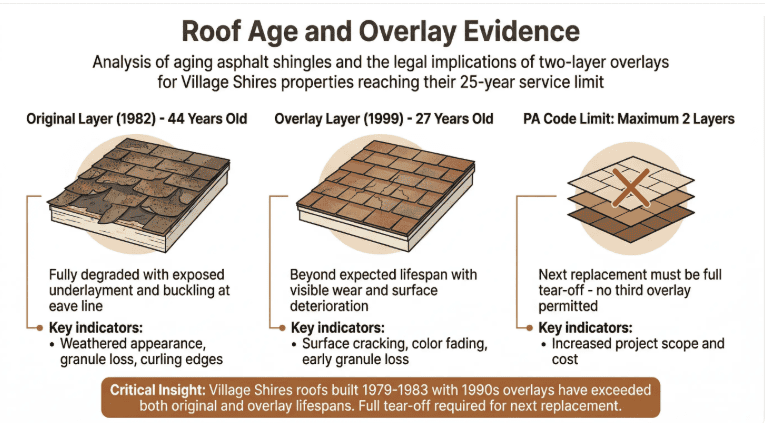
Village Shires was built from 1979 to 1983. Any community built in the first phases — Heather Valley I, Country Place I, the original Beacon Hill sections — that hasn’t had a documented roof replacement in this century is overdue. Architectural asphalt shingles last 25–30 years in Bucks County’s climate. A 1982 roof with a 1999 overlay is now 27 years into that overlay’s service life. For condo owners: request your association’s roof replacement history from Danella Management or the board. For townhome and single-home owners: check your closing documents or contact a professional inspector.
Sign 2 — Recurring Maintenance Calls for the Same Water Intrusion Point
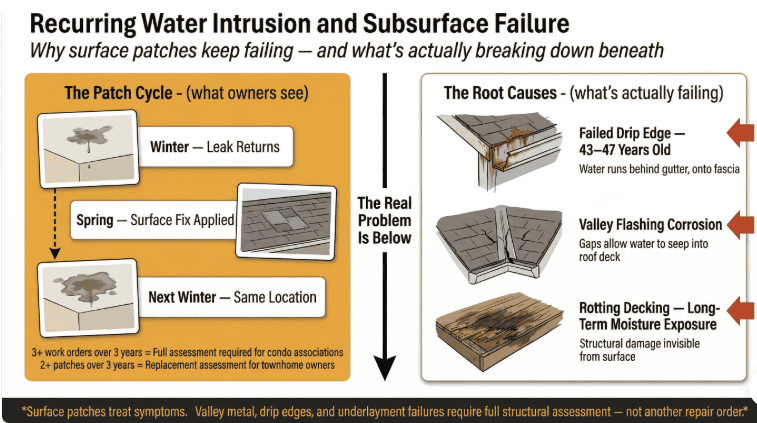
The single most reliable indicator that a Village Shires condo or townhome building section needs a complete roof assessment rather than another patch repair is the recurring-patch pattern — the same unit generates a water intrusion call every winter, the patch holds through summer, and the call comes back the following winter. This pattern indicates that patches are addressing the symptom (visible surface damage) rather than the cause (failed valley metal beneath the shingles, corroded drip edge, deteriorated substrate). For condo boards: three or more work orders for the same building section over three years should trigger a full condition assessment. For townhome owners: two patch repairs in three years on the same section is the threshold for a replacement assessment.
Sign 3 — Two Visible Shingle Layers at the Eave Edge
Look at your roofline from below at the eave edge. Two distinct shingle courses stacked — one layer visibly on top of an earlier course — indicate an overlay installation. Pennsylvania code limits roofs to a maximum of two shingle layers. Any Village Shires building that already has two layers cannot receive a third overlay — the next replacement is legally required to be a full two-layer tear-off. This changes the cost calculation significantly and should be reflected in any reserve fund or personal savings planning. For all property types: check the eave edge of any Village Shires building before assuming the next re-roof will be a standard overlay cost.
Sign 4 — Soffit or Fascia Staining at the Eave Line
Dark staining or rot beginning on soffit panels or fascia boards at the eave line is a visible indicator of one of two conditions: failed drip edge, allowing water to run behind the gutter and onto the fascia, or ice-dam water penetrating under the first shingle course at the eave. On Village Shires buildings from the early 1980s, original drip edge installations are now 43–47 years old — these have typically corroded to the point of functional failure. For all property types: soffit or fascia staining warrants an immediate professional assessment, not a paint-and-move-on response.
Sign 5 — Granules Accumulating in Gutters or at Downspout Outlets
Significant dark, sandy deposits in gutters or concentrated at downspout discharge points indicate that the shingles’ UV-protective granule coating is failing. For Village Shires buildings with multiple connected units draining to shared gutters, granule concentration patterns can identify which building section is the primary source — useful information for both association boards planning assessments and individual townhome owners preparing for replacement. For condo associations: heavy granule deposits in gutters serving multiple-unit buildings are an indicator for the board’s reserve fund review, not just a gutter cleaning item.
Sign 6 — Interior Ceiling Staining in Condo Units or Upper-Floor Rooms
Water staining on upper-floor ceilings or walls is always a symptom of a failure that has already occurred, typically for multiple seasons before becoming visible. For Village Shires condo owners, interior staining should be reported in writing to the association board or Danella Management immediately. The board is obligated to investigate the roof structure above the stain. For townhome and single-home owners, interior staining warrants a professional contractor inspection within days — not at the next convenient scheduling window.
Sign 7 — The Reserve Study Projects Roofing Replacement in the Next 3 Years
This warning sign applies specifically to Village Shires condo association unit owners. If you’ve reviewed your association’s reserve study and seen that the roof is projected for replacement within 3 years, the time to ensure the contractor selection process is underway is now — not at the start of the project year. Reserve study timelines are often optimistic. A professional condition assessment 2–3 years before the projected replacement date either confirms the timeline or identifies accelerated deterioration that requires moving the project forward. For condo board members: proactively commissioning a condition assessment 2–3 years before the reserve projection is the most cost-effective risk management for the roofing line item.
Free Condition Assessments for All Village Shires Property Types
Paragon Exterior provides free roof condition assessments for Village Shires condo association boards, townhome owners, and Heather Valley single-home owners. Call (215) 799-7663.
Frequently Asked Questions
How old are the roofs in Village Shires PA?
Village Shires was built primarily from 1979 to 1983. Original systems are 43–47 years old — most communities are on their second or third roof. First-generation replacements from the 1990s are 25–35 years old and are approaching or have exceeded their service life. Second-generation 2000s replacements are 20–25 years old and entering the inspection window.
Who is responsible for noticing roof failure signs in Village Shires condo buildings?
The condo association board has fiduciary responsibility for the roof structure. Unit owners who observe interior water staining, ceiling damage, or visible exterior deterioration should promptly report these observations in writing to the board or Danella Management. Early reporting allows manageable conditions to be addressed before they become crisis replacements.
Can a Village Shires condo owner hire their own roofer to fix the roof above their unit?
Generally, no — in most Village Shires condo structures, the roof is association property and repair/replacement is the association’s responsibility. Individual unit owners who hire contractors to work on the building’s roof without board authorization may create insurance complications and damage liability. Report the condition to the board and request that the association take action.
About the Author
Maxwell Martin, CEO, Paragon Exterior LLC
Maxwell Martin has 20+ years of experience in the exterior remodeling industry, specializing in residential and historic roofing across Philadelphia, Bucks County, and the greater Delaware Valley. Paragon Exterior holds PA License #PA197973, GAF certification with access to the Golden Pledge warranty, and a 4.9-star rating across 100+ verified Google reviews.
