
Signs You Need a New Roof in Somerton PA
What Failure Looks Like on Flat Roofs and Shingle Roofs — Both
Knowing the 7 signs you need a new roof in Somerton PA is more nuanced than in most Philadelphia neighborhoods — because Somerton’s housing stock includes both flat-roof row homes and pitched-shingle detached homes, and roof failure looks entirely different on each. Most online guides only describe shingle roof failure. If you live in a Somerton row home, those guides are describing someone else’s problem.
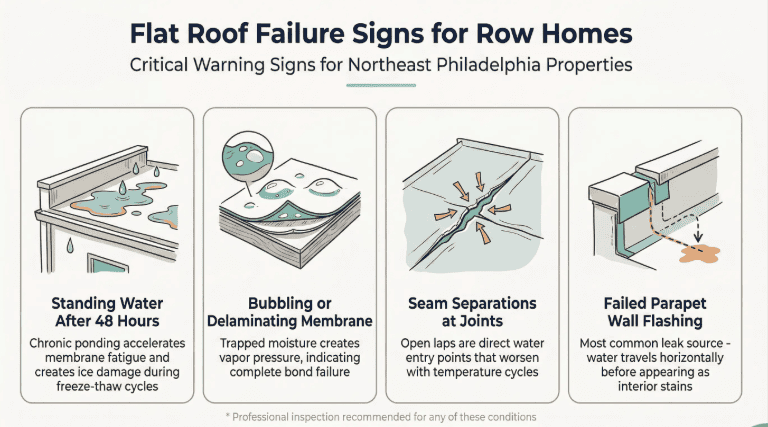
FOR FLAT ROOF ROW HOME OWNERS
Sign 1 — Standing Water That Doesn’t Drain Within 48 Hours
Some ponding after heavy rain is normal on flat roofs. Water that still hasn’t drained 48 hours after a rain event indicates a drainage problem — either a clogged drain, a settled roof deck that has lost its slope toward the drain, or both. Chronic ponding is the number one cause of premature flat roof failure in Northeast Philadelphia. The weight of standing water accelerates membrane fatigue, and the freeze-thaw cycle turns that standing water into an ice lens that pries at seams and flashing edges all winter.
Sign 2 — Bubbling, Blistering, or Delaminating Membrane
Walk your flat roof on a dry day and look for bubbles or raised sections where the membrane has separated from the deck beneath it. Blistering means moisture has gotten between the membrane and the substrate and is being heated by the summer sun to the point of vapor pressure. Delamination — where the membrane peels or lifts from the deck — indicates the adhesive bond has failed. Both conditions mean the membrane is no longer performing as a waterproof barrier, and replacement is the correct call, not another patch.
Sign 3 — Visible Seam Separations or Open Laps
The seams where modified bitumen plies overlap are the most vulnerable points of a flat roof. As the membrane ages and goes through thousands of temperature cycles, the seam bond weakens. Visible seam gaps — even small ones — are water entry points waiting for the next heavy rain. A seam that has separated once will separate again after a patch because the surrounding membrane has already lost its dimensional stability.
Sign 4 — Failed Parapet Wall Flashing
The flashing at the perimeter wall of a Somerton row home — particularly at shared walls with neighbors — is the single most common source of flat roof leaks. Look from the inside: water stains that track along a top-floor wall or ceiling near the building’s perimeter almost always indicate parapet counterflashing failure, not a membrane failure at the center of the roof. This is why patches at the drain area often don’t fix a leak that’s actually entering at the wall.
FOR PITCHED ROOF HOMEOWNERS ON SOMERTON DETACHED PROPERTIES
Sign 5 — Shingles That Are 20+ Years Old
Standard architectural asphalt shingles last 25–30 years in Philadelphia’s climate. 3-tab shingles last 20–25 years. Northeast Philadelphia’s freeze-thaw cycling — temperatures crossing the freeze threshold 30–50 times per winter — degrades shingle integrity faster than warmer climates. If your Somerton detached home has its original shingles from the early 2000s or earlier, annual professional inspection is the minimum appropriate response.
Sign 6 — Shingles Curling, Cupping, or Shedding Granules
Curling shingle edges (cupping) or shingles bowing upward at the center (clawing) indicate moisture imbalance or inadequate attic ventilation. Significant granule accumulation in gutters means the shingles’ UV-protective coating is failing. Both conditions indicate that the roof is approaching the end of its service life. Widespread curling across multiple roof planes indicates a systemic, not isolated, condition — this is a replacement situation, not a repair.
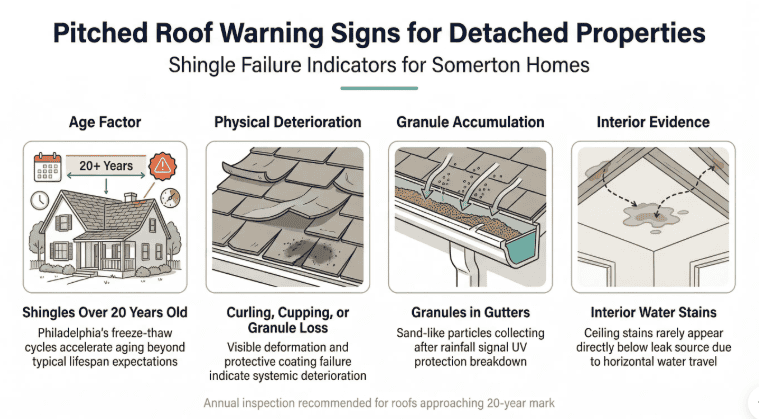
Sign 7 — Interior Water Stains on Ceilings or Walls (Either Roof Type)
An interior water stain is always a symptom of a roof failure that has already occurred — not a warning of one about to happen. On flat-roof row homes, stains often appear near perimeter walls (parapet flashing failure) or below the drain (drain or membrane failure). On pitched-roof homes, the stain is almost never directly below the entry point — water travels along rafters before dripping onto drywall. Either way, interior staining means the roof has already failed, and an inspection is needed immediately, not at the next convenient time.
When to Call a Professional Roofing Contractor
Signs 1 through 4 (flat roof) and signs 5 through 7 (pitched or either type) all warrant a professional inspection. Paragon Exterior provides free roof inspections for Somerton and Northeast Philadelphia homeowners covering both roof types in a single visit. Call (215) 799-7663.
Frequently Asked Questions
How long does a flat roof last on a Somerton row home?
A properly installed modified bitumen flat roof typically lasts 15–20 years. EPDM rubber lasts 20–25 years. TPO membranes last 20–30 years. Clogged drains, failed parapet flashing, and deferred maintenance significantly shorten these lifespans. Annual inspection of drains and seams is strongly recommended for row homes in Northeast Philadelphia.
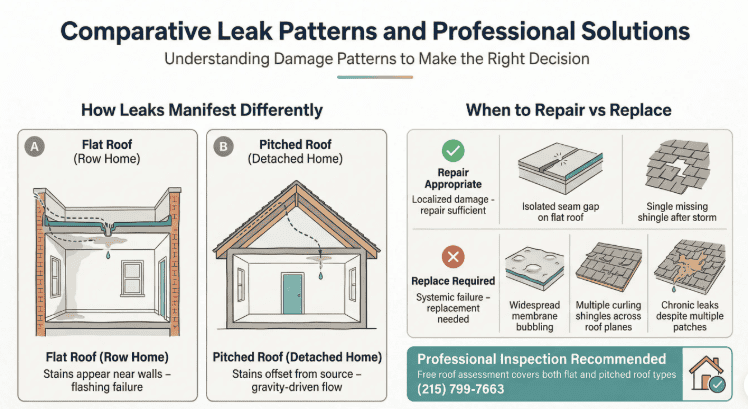
Can I repair my flat roof in Somerton instead of replacing it?
Repair is appropriate when damage is isolated — a single seam separation, a small puncture, or a failed drain collar that hasn’t compromised the surrounding membrane. Replacement is right when the membrane is bubbling or delaminating across large areas, when the decking beneath is soft, or when the roof has been patched multiple times without resolving recurring leaks.
What does shingle roof failure look like on a Somerton detached home?
Warning signs include curling or cupping shingle edges, visible granule loss that creates dark patches, missing shingles after wind events, dark attic staining, and interior water stains. Somerton’s freeze-thaw climate accelerates shingle aging — architectural shingles over 20 years old should be professionally inspected annually.
About the Author
Maxwell Martin, CEO, Paragon Exterior LLC
Maxwell Martin has 20+ years of experience in the exterior remodeling industry, specializing in residential and historic roofing across Philadelphia, Bucks County, and the greater Delaware Valley. Paragon Exterior holds PA License #PA197973, GAF certification with access to the Golden Pledge warranty, and a 4.9-star rating across 100+ verified Google reviews.
