
Roof Replacement in Holland, PA: 1980s Colonial Case Study
When the Second Re-Roof Reveals What the First One Covered Up
This roofing contractor for a roof replacement in Holland PA started the way many do in Council Rock School District neighborhoods — with a homeowner who had moved to Holland in the 1990s for the schools, raised their kids there, and had been watching a ceiling stain in the second-floor hallway grow incrementally larger for two years. The home was a 1984 colonial on a quiet cul-de-sac in one of Holland’s established neighborhoods, and it had been re-roofed once, around 2001. That re-roof had covered up a problem rather than solving it.
What We Found During the Inspection
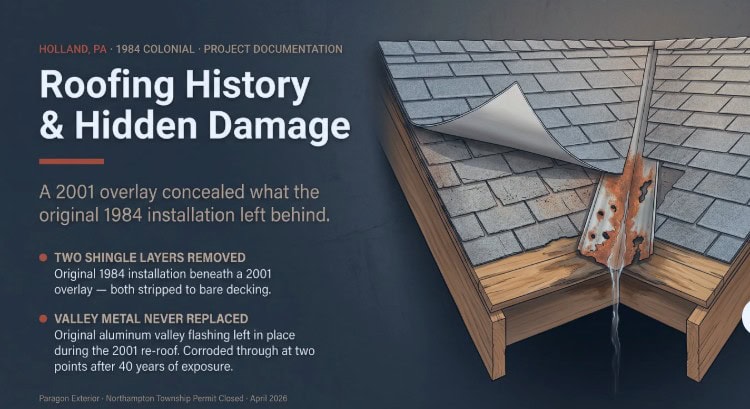
The 2001 re-roof had been installed as an overlay — the second-generation shingles were nailed over the original 1984 installation rather than a full tear-off. This is common in homes in Holland from this era; in the early 2000s, overlay was frequently presented as a cost-saving approach. Pennsylvania building code now limits roofs to a maximum of two shingle layers, and the 2001 overlay had been applied to a first layer that was already showing its age. When we tore off both layers for the current replacement, what we found underneath explained the ceiling stain.
The valley decking at the rear of the home — the section that drains the larger roof plane toward the single-story addition — had extensive moisture damage. The valley metal from the 1984 installation had been left in place during the 2001 overlay. Over 22 additional years, that original valley metal had corroded through at two points, allowing water to migrate under the shingles and into the decking below. The staining the homeowners had been watching was water tracking from that valley point along a rafter to the hallway ceiling below.
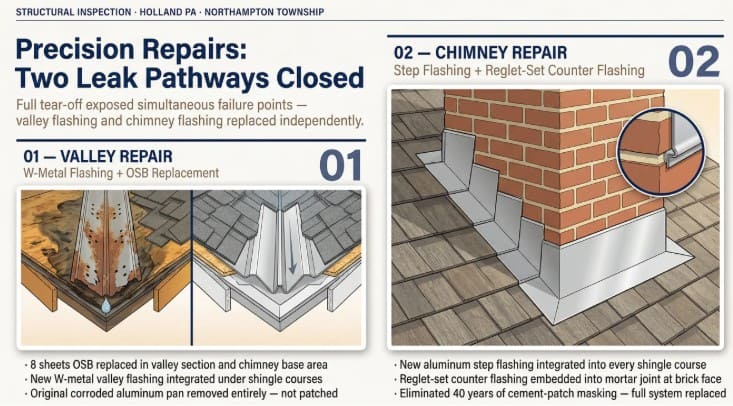
The chimney flashings were originally 1984 aluminum — patched with roofing cement at least twice over the home’s 40-year history. The step flashing on the chimney’s south face had separated from the brick entirely on one course, creating a direct water path into the wall cavity. This was a separate leak pathway from the valley issue — two simultaneous entry points.
Decking condition was mixed. The main house decking — original plank sheathing from 1984 — was sound. The addition of roof decking was OSB from a later repair and was also intact. Eight sheets of OSB replacement were needed in the valley section and immediately around the chimney base, where moisture had tracked from the flashing failure.
Our Solution
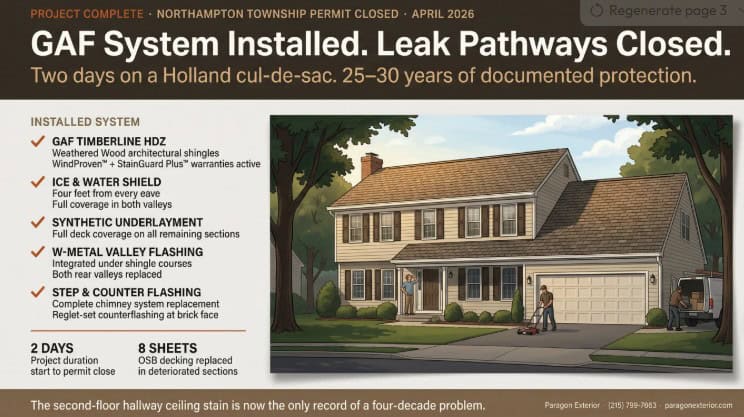
Full tear-off to bare decking on all sections. We replaced both valley sections with new W-metal valley flashing integrated under the new shingles. The chimney received a complete step and counter-flashing replacement — new aluminum step flashing integrated into the shingle courses, and new reglet-set counter-flashing at the brick face. Eight sheets of OSB were replaced in the two deteriorated areas.
We installed GAF Timberline HDZ architectural shingles in Weathered Wood — a popular choice in Holland’s established neighborhoods for its warm dimensional profile. Ice and water shield extended to four feet from every eave and provided full coverage in both valleys. Synthetic underlayment across the remaining deck area.
The Process — Two Days on a Holland Cul-De-Sac
Day one: full tear-off of both shingle layers completed by 1 pm. Decking inspection, OSB replacement in deteriorated sections, and installation of valley/chimney flashing were completed by the end of the day. Underlayment installed across the full deck before the crew left — no overnight weather exposure. Day two: full shingle installation, ridge cap, gutter apron replacement, final cleanup, including magnetic nail sweep of the cul-de-sac. The homeowners noted the crew was done and cleared out by 3 pm.
The Result
The ceiling stain is the last record of the problem. With the valley metal replaced, both independent leak pathways closed, and the full GAF system warranty activated, this Holland colonial has a documented, warranted, properly permitted roof for the next 25–30 years. The Northampton Township permit is closed out and in the homeowners’ file.
What This Project Taught Us
The most expensive roofing decisions in Holland’s established neighborhoods aren’t dramatic failures — they’re the overlay jobs done in the early 2000s that covered up rather than fixed the original failure points. A thorough inspection before any pricing conversation is the only way to know what’s actually under the surface on a 1980s Holland home. Call Paragon Exterior at (215) 799-7663 for a proper assessment before approving any scope of roofing work on an older Holland property.
Frequently Asked Questions
How long does a full roof replacement take on a colonial in Holland, PA?
Most Holland colonial replacements are complete in one to two days. A standard 24-square colonial with no significant decking issues can be completed in one full day. Decking replacement adds a half-day to a full day. Paragon Exterior provides a specific timeline in every written estimate.
Should I tell my neighbors before a Holland roof replacement?
It’s courteous and helpful, especially on Holland’s cul-de-sacs where dumpster placement may temporarily affect street access. Paragon’s crew handles neighbor notifications on the morning of installation, but a homeowner’s heads-up the day before is always appreciated.
About the Author
Maxwell Martin, CEO, Paragon Exterior LLC
Maxwell Martin has 20+ years of experience in the exterior remodeling industry, specializing in residential and historic roofing across Philadelphia, Bucks County, and the greater Delaware Valley. Paragon Exterior holds PA License #PA197973, GAF certification with access to the Golden Pledge warranty, and a 4.9-star rating across 100+ verified Google reviews.
