
Penndel, PA Fall Roof Maintenance
What Penndel’s Borough Homeowners Need to Do Before Lower Bucks County Winter
The Penndel, PA, fall Roofing Contractor for maintenance checklist is organized around the three conditions that make Penndel’s pre-winter maintenance different from standard Lower Bucks County guidance: the age and construction characteristics of the borough’s historic housing stock, the Route 1 vibration factor for properties near the commercial corridor, and the compact borough street logistics that affect how maintenance work is performed. Here is what to do before the first hard freeze.
1. Chimney Flashing Visual Inspection — September/October
This is the highest-priority fall maintenance item for any Penndel pre-WWII home. From ground level with binoculars, examine all four sides of every chimney. Look for: any gap between the counterflashing metal and the brick face, any visible rust staining on the exterior wall below the chimney flashing line, any section where counterflashing is lifting away from the brick at the top edge, and any point where the flashing-to-shingle integration looks separated or buckled. For Route 1-adjacent Penndel properties, also look specifically at the Route 1-facing side of each chimney — this is the side with the highest vibration exposure and the side where counterflashing loosening most commonly begins. Call a pro if: any visible gap, lifting, rust staining, or surface caulk over what should be a clean metal-to-brick junction.
2. Route 1-Adjacent Flashing Spot Check — October
Penndel homeowners on streets with direct Route 1 or Lincoln Highway vibration exposure should add one specific fall check that homeowners on quieter Penndel streets don’t need: a visual assessment of all visible wall-to-roof transition flashings — dormer sidewalls, chimney step flashings visible from the side, and any low-slope section where the roof meets a vertical wall. Look for any flashing that is not fully flat against the wall surface. Any gap at the flashing edge indicates that fasteners are loosening due to vibration-related fatigue. This is a subtle sign that requires attention — it won’t look dramatic, but left to a winter freeze-thaw cycle, the gap widens, and water enters. Call a pro if any wall-to-roof flashing is not fully flush with the adjacent surface.
3. Full Gutter Cleaning and Inspection — Late October
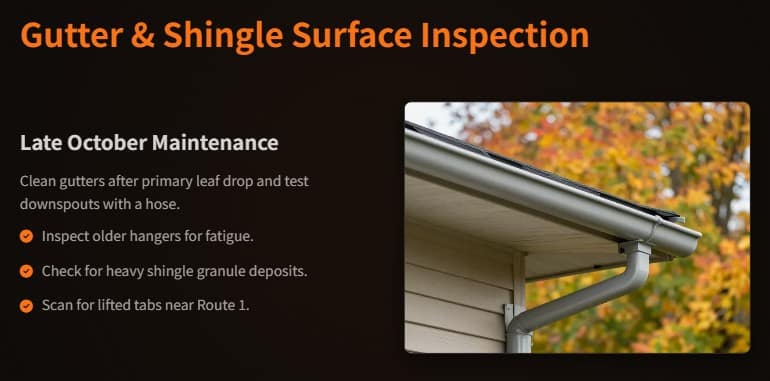
After Penndel’s borough street trees have dropped the majority of their leaves (typically mid-to-late October), clean all gutters and test every downspout with a hose. For pre-WWII Penndel homes with original-era or 1950s–1970s replacement gutters, also inspect every hanger — older gutters on homes that have been through many winters may have fatigued hangers that are one significant ice event away from separating from the fascia. Also check for granule accumulation in gutters — heavy deposits indicate the shingles are approaching the end of life. DIY difficulty: Low. Call a pro if: downspouts don’t clear, multiple hangers fail, or heavy granule deposits appear.
4. Plank Sheathing Attic Check — October
Pre-WWII Penndel homes with original plank sheathing should include a fall attic check as part of annual maintenance. On a dry sunny day, go to the attic with a flashlight and look for pinpoints of daylight through the deck boards. Then check the boards themselves: run your hand across the underside of the decking and probe for any soft, punky, or damp areas. On Penndel pre-WWII homes, plank boards that have been under aging shingles for decades may have begun to deteriorate without yet producing interior ceiling stains — the attic check catches this condition before it progresses to structural compromise. Call a pro if: any daylight, soft boards, or moisture staining.
5. Vent Pipe Boot Check — October
Every plumbing vent stack that exits through the roof has a rubber boot seal at its base. On Penndel’s older homes, these boots — some original to the 1950s–1970s plumbing systems — crack due to UV exposure and thermal cycling. A failed vent boot on a Penndel home is a specific, inexpensive repair when caught in fall; a winter freeze-thaw cycle that pushes through a failed boot seal creates a more significant moisture event. From ground level with binoculars, look for any vent stack where the boot appears cracked, misshapen, or separated from the pipe. Call a pro for any failed boot on a section inaccessible from a standard extension ladder.
6. Shingle Surface Visual Check — October
From ground level with binoculars, walk the full perimeter and look at all roof planes. Check for: missing or lifted shingle tabs (pay particular attention to areas nearest Route 1 where vibration-related sealant strip loosening begins), dark patches indicating granule loss, and any visible unevenness in the roof plane that could indicate decking deterioration beneath. For Penndel homes near the Route 1 corridor, also look for the early pattern of lifted tab edges near wall transitions — an early indicator of vibration-related sealant degradation. Call a pro for: any missing shingles, widespread granule loss, or lifted tab edges near wall transitions.
7. Compact Borough Street Logistics for Any Fall Work
Penndel’s residential streets are tight — no expansive suburban driveways, no setback yards for staging, and parking is shared with neighbors who have their own routines. For any fall repair work scheduled in October or November, plan the logistics in advance: confirm with your contractor how dumpster placement will work on your specific street, give immediate neighbors a heads-up at least a day before any crew work begins, and ensure vehicles are moved to provide access. The compact borough environment requires a bit more pre-coordination than suburban roofing jobs — Paragon Exterior handles all of this as standard project logistics.
When to Call Paragon Exterior Before Winter
Any chimney flashing gap, Route 1-adjacent flashing that isn’t flush, attic moisture signs, failed vent boots, or missing shingles warrant a professional visit before Penndel’s first hard freeze. Free inspections for all Penndel Borough properties. Call (215) 799-7663.

Frequently Asked Questions
When should I schedule my fall roof inspection in Penndel, PA?
October is ideal — after primary leaf drop, so gutters can be fully assessed, and before the first hard freeze, which limits repair options. For pre-WWII homes with original masonry chimneys, scheduling the chimney flashing assessment before sustained cold weather is especially important.
What is the most important fall maintenance task for a Penndel, PA, historic home?
The chimney flashing visual check. On pre-WWII Penndel homes, original or patched chimney counterflashing is the most common source of winter leak events. A separated counterflashing identified in October can be properly repaired before winter; the same failure in January, after ice has entered the wall cavity, requires substantially more remediation.
About the Author
Maxwell Martin, CEO, Paragon Exterior LLC
Maxwell Martin has 20+ years of experience in the exterior remodeling industry, specializing in residential and historic roofing across Philadelphia, Bucks County, and the greater Delaware Valley. Paragon Exterior holds PA License #PA197973, GAF certification with access to the Golden Pledge warranty, and a 4.9-star rating across 100+ verified Google reviews.
