
When the Current Roof Is the Third Generation and Carries the Problems of the two prior ones
This Oakford, PA, roofing contractor project represents the quintessential Middletown Township 1950s home challenge — a 1955 Cape Cod on a quiet Oakford street, one of thousands of similar homes built in the years following Levittown’s transformation of Lower Bucks County from farmland to suburb. The home had been re-roofed twice in its 71-year history: once in the early 1980s and again in the mid-2000s. When the homeowner called, the mid-2000s re-roof was now 20+ years old and showing the typical end-of-service-life pattern — granule loss on the south-facing slope, lifted tab edges on the north slope where the sealant strips had hardened, and a recurring small stain in the second-floor bedroom ceiling that had been appearing every winter for three years.

What the Inspection Found
Two confirmed shingle layers. Looking at the eave edge from ground level before the inspection was even complete, two visible shingle courses were stacked at the fascia, confirming the two-layer overlay. Pennsylvania code required a full tear-off to bare substrate before new installation could proceed. This was disclosed in writing before the estimate was prepared.
Original 1955 horizontal board sheathing, mostly sound. Under both shingle layers, the original board sheathing from 1955 was revealed — individual horizontal boards, 3/4-inch thick, with small gaps between them. The majority of the boards were in surprisingly good condition: dry, flat, with no soft spots. The exception was a 6-board section at the base of the north slope valley — the section that drained the main roof into the gutter over the bedroom ceiling, where the recurring stain appeared. Those six boards showed moisture damage from a valley that had been draining poorly for an unknown number of seasons.
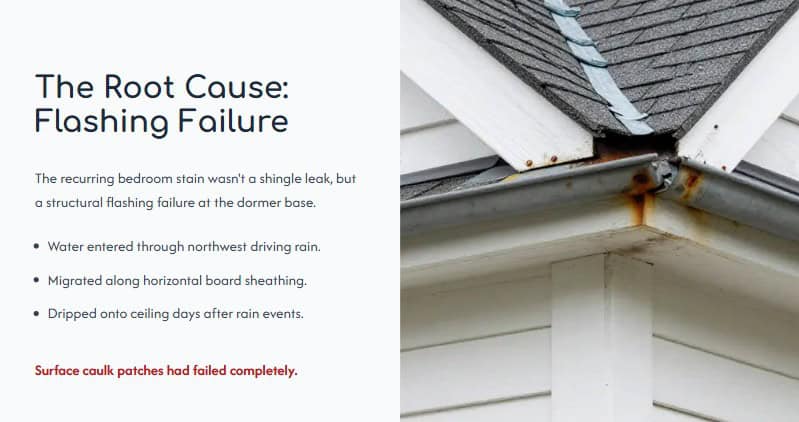
Dormer flashing failure on the left dormer. The left front dormer — the one visible from the street — had step flashing at its base that had separated from the main roof at two courses. Surface caulk had been applied at some point to bridge the gap, but it had dried and cracked, leaving a direct entry point for water during driving rain from the northwest. This was the source of the three-year recurring bedroom ceiling stain: water entering at the dormer base, tracking along the horizontal boards, and dripping onto the ceiling below, not during the rain event itself but days afterward as it migrated through the dried-out board substrate.
Chimney counterflashing — original, patched once. The chimney had what appeared to be its original 1955 lead counterflashing, with a 1980s-era caulk application over the top edge where the lead had lifted from the brick face. The lead itself was still largely intact, but the caulk bridge had failed at two points. A full counterflashing replacement was the right call, rather than another caulk application.
The Solution
Full two-layer tear-off to bare substrate. Six north-slope boards replaced with matching 3/4-inch plywood. Ice and water shield extended to five feet from both eaves (given the north slope’s history) and full coverage in all valleys. New step and counterflashing at both dormers — left dormer received a full step-flashing replacement, interleaved with the new shingles; right dormer’s original flashing was sound and retained, with a new counterflashing set. Chimney received a complete counterflashing replacement — a new lead-coated copper reglet set into the brick mortar joint, eliminating the caulk-bridge approach entirely.
GAF Timberline HDZ architectural shingles in Charcoal — a period-appropriate dimensional profile that complements the original Cape Cod character of the home. New drip edge throughout. Middletown Township permit issued, inspected, and closed out.
The Result
The three-year bedroom ceiling stain is resolved. Both dormers are properly flashed for the first time in decades. The chimney is sealed at the masonry rather than caulked at the surface. The majority of the original 1955 horizontal board sheathing — sound after 71 years — was retained as a valid substrate, which the homeowner appreciated as a connection to the home’s original construction. The Middletown Township permit is closed out and in the documentation file. Call (215) 799-7663 for a free inspection on any Oakford 1950s Cape Cod or ranch.

Frequently Asked Questions
How long does a roof replacement take on a 1950s Oakford, PA, Cape Cod?
Most 1950s Oakford Cape Cods can be completed in one to two days. A standard Cape Cod with two dormers and no significant decking issues can be completed in one full day. Dormer reflashing complexity, board sheathing replacement, or two-layer overlay removal can add time. Paragon Exterior provides a specific timeline in every written estimate.
Can the original horizontal board sheathing on a 1950s Oakford Cape Cod be retained?
Yes, if structurally sound. Original horizontal board sheathing that is dry, tight, and adequately fastened can serve as a valid substrate for new shingles. Deteriorated sections are replaced with plywood of matching thickness. Paragon assesses every board section during inspection and prices contingency replacement before work begins — no post-start surprises.
About the Author
Maxwell Martin, CEO, Paragon Exterior LLC
Maxwell Martin has 20+ years of experience in the exterior remodeling industry, specializing in residential and historic roofing across Philadelphia, Bucks County, and the greater Delaware Valley. Paragon Exterior holds PA License #PA197973, GAF certification with access to the Golden Pledge warranty, and a 4.9-star rating across 100+ verified Google reviews.
