
Linconia PA Roof Replacement: Multi-Gen Home Case Study
When “The Roof Was Done” Is All the Documentation You Have
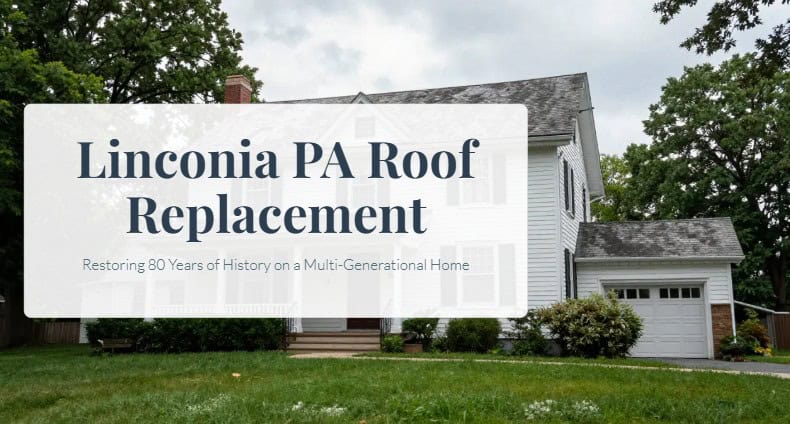
This Linconia PA roofing contractor for replacement project represents the most common challenge in this historic community — a home built in the early 1930s as part of Frank K. Brown’s original Linconia development, owned by one family across three generations, with a roofing history that could be summarized by the third-generation owner in a single sentence: “My grandmother had it done sometime in the 1980s, and my mom had something done around 2005.” No contractor names. No records. No material specifications. Just the certainty that work had been done, and a roof that was now actively leaking in the dining room every time it rained.
What the Inspection Found
One confirmed shingle layer. Looking at the eave edge, one shingle course is visible. The 2005 work had apparently been a full tear-off rather than an overlay. This was the good news: a full tear-off to the original substrate was what this home needed, and with only one layer to remove, the cost of that tear-off was straightforward to estimate.
Original 1930s board sheathing in mixed condition. Under the single layer, the original board sheathing from the early 1930s was revealed. This sheathing was now approximately 90–95 years old. The condition varied dramatically by location: the south-facing and well-ventilated sections were in excellent shape — dry, tight boards with no soft spots. The north-facing section, which had been under a valley with evidence of poor drainage, had two sections of soft, deteriorated boards totaling approximately 8 boards, which required replacement. The attic access had already suggested this — there was visible rafter staining along the north-slope valley that had been accumulating over multiple seasons.
The chimney — the source of the dining room leak. The chimney counterflashing on the primary chimney was original to the 1930s structure. It had been caulked at least twice — once with a grey roofing cement in what appeared to be a 1980s application, and once more recently with a clear sealant that had since yellowed and cracked. The original lead counterflashing had separated from the brick face on the north side by approximately 3/4 of an inch — more than enough for driving rain to enter at the brick face and run down through the board sheathing to the dining room ceiling below.
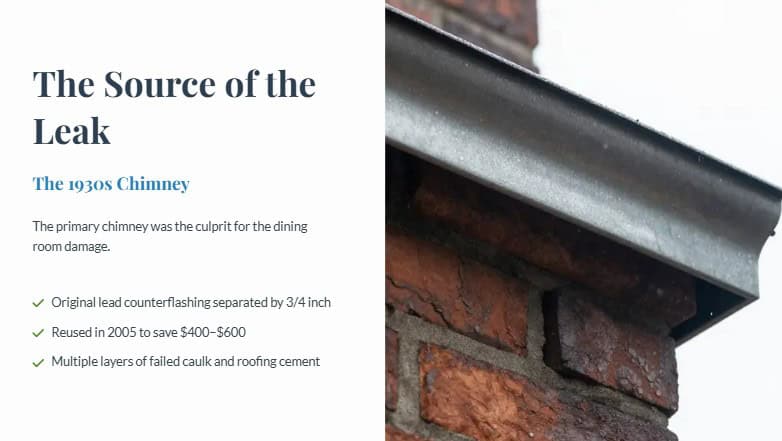
The 2005 work’s legacy. The 2005 installation appeared to have been competently done on the shingles themselves — the shingle condition was consistent with 21-year-old architectural shingles approaching the end of service life. However, the 2005 work had reused the original 1930s chimney counterflashing rather than replacing it — a common cost-cutting measure that saved perhaps $400–$600 at the time and had been creating the dining room leak for an unknown number of seasons.
The Solution
Full tear-off to bare board sheathing. Eight boards replaced on the north slope — exactly the boards identified in the inspection, no more and no less, priced in the estimate as a contingency before work began. Complete chimney step and counterflashing replacement — new lead-coated copper reglet set into the brick mortar joint, eliminating the surface-caulk approach entirely. New valley metal throughout. New drip edge throughout — the original 1930s drip edge had long since corroded past functional life.
GAF Timberline HDZ architectural shingles in Weathered Wood — a period-appropriate color that complements the home’s original character. Ice and water shield extended to four feet from every eave and full valley coverage. Bensalem Township permit applied for, approved, and inspected. Project completed in two days.
The Conversation About the Chimney
The third-generation owner’s reaction when we showed him the photographs of the original counterflashing and explained that the 2005 contractor had reused rather than replaced it: “So we’ve been leaking since 2005?” The honest answer: possibly longer than that — the original counterflashing may have been slowly failing for years before 2005, and the 2005 work may have masked but not resolved the leak pathway. The dining room stain, which had been there as long as the family could remember, was consistent with a chronic, low-level leak that had been accepted as a feature of the house rather than diagnosed as a roofing failure.
The Result
The dining room stain is the last record of the problem. The north-slope board sheathing has been properly rebuilt. Both the chimney flashing and the valley that was draining poorly are addressed for the next generation. The Bensalem Township permit is closed out and in the documentation file — the first documented roofing record for this property since it was built in the early 1930s. Call (215) 799-7663 for a free inspection on any Linconia multi-generational property.

Frequently Asked Questions
How long does a roof replacement take on a Linconia PA historic home?
Most Linconia historic homes take one to three days, depending on size, complexity, and what is found at tear-off. Significant board sheathing replacement, multiple chimney flashings, or a complex, accumulated repair history extend the timeline. Paragon provides a specific timeline in every written estimate.
How do you assess a Linconia home when the roofing history is completely unknown?
Start with layer count at the eave edge, chimney counterflashing condition on all visible sides, and valley/transition flashings. Then attic access to evaluate board sheathing, moisture staining on rafters, and any daylight through the deck. Combined, these give a reasonable picture of what will be found at tear-off, incorporated into the estimate as a contingency rather than a post-start surprise.
About the Author
Maxwell Martin, CEO, Paragon Exterior LLC
Maxwell Martin has 20+ years of experience in the exterior remodeling industry, specializing in residential and historic roofing across Philadelphia, Bucks County, and the greater Delaware Valley. Paragon Exterior holds PA License #PA197973, GAF certification with access to the Golden Pledge warranty, and a 4.9-star rating across 100+ verified Google reviews.
