
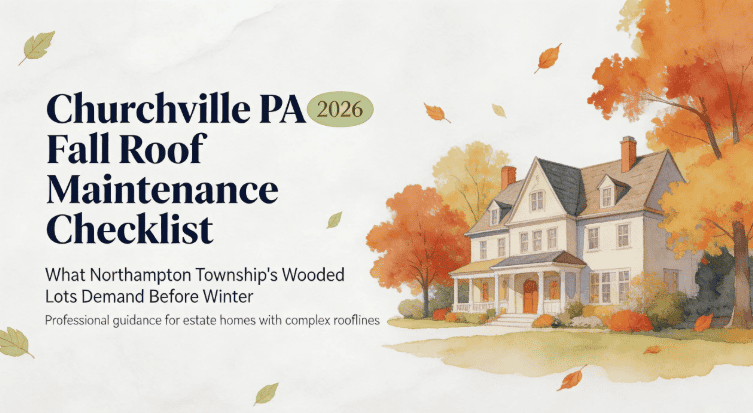
What Northampton Township’s Wooded Lots Demand Before Winter
The Churchville, PA, fall Roofing Contractor maintenance checklist is longer than the standard Bucks County guide — and for good reason. Churchville’s heavily wooded lots, mature hardwood canopy, and estate-scale rooflines with multiple valleys create fall maintenance requirements that simply don’t apply to the standard suburban colonial. This checklist covers what Churchville homeowners need to do before Northampton Township’s winter locks in.
1. Full Valley Clearing and Inspection — After Primary Leaf Drop (Late October/Early November)
On a Churchville wooded-lot estate home, this is the single most important fall maintenance task. Valleys accumulate the deepest debris concentrations of any roof section — leaves pack into V-intersections by the pound, not the handful, and they hold moisture against the underlying roofing material through every rain and freeze event until spring. Clear all valleys manually (not just blow leaves off the flat surfaces), then inspect the valley metal or shingles for signs of granule loss, surface softening, or membrane damage from chronic debris contact. DIY difficulty: Moderate in accessible valleys. Call a pro for steep-pitch valleys, any metal damage in valleys, or soft surface conditions.
2. Full Gutter Cleaning — After Complete Leaf Drop (November)
Wait until the leaves have fully fallen on Churchville’s mixed hardwood lots — often extending to mid-November. Clean all gutters and downspout openings completely. On estate homes with large gutter runs and multiple downspouts, check that every downspout runs freely with a hose test. Blocked downspouts on estate homes create backups that extend into the gutter system, pushing water over the gutter edge and against the fascia during freeze events. DIY difficulty: Low to Moderate, depending on gutter height and length. Call a pro if gutters are high-set on a steep-pitched estate home, or if downspouts don’t clear during a hose test.
3. Moss and Algae Inspection — October
October is the ideal time to assess moss coverage before it gets buried under leaf debris. Walk the property and look at all north-facing and heavily shaded roof planes. Moss appears as green or dark patches on the shingle surface; algae appears as dark streaking (often called “black streaks” though the color is actually blue-green algae staining). Either condition on a Churchville-shaded lot requires treatment before winter—moss, particularly, because freeze-thaw cycling drives its root structure deeper under shingle tabs during the winter months. Minor moss coverage can be treated with appropriate biocide products. Heavy moss coverage on shingles, already showing granule loss, indicates a need to discuss replacement timing, not just cleaning. Call a pro for: any assessment of moss coverage severity and remaining shingle life.
4. Chimney Inspection — October/November
Churchville’s historic estate homes and farmhouses often have substantial fieldstone or brick chimneys with multiple flashings. Inspect from the ground with binoculars: check that the chimney cap is intact and seated, look for visible mortar joint deterioration in the brick or stonework, and check from the interior for any fresh staining on ceilings adjacent to chimney walls (a seasonal chimney flashing leak often appears as a new or expanded stain after the first significant autumn rain). DIY difficulty: Ground inspection is low. Call a pro for: any visible counterflashing separation, fresh staining, or deteriorated chimney masonry.
5. Tree Branch Assessment — October (Before First Freeze)
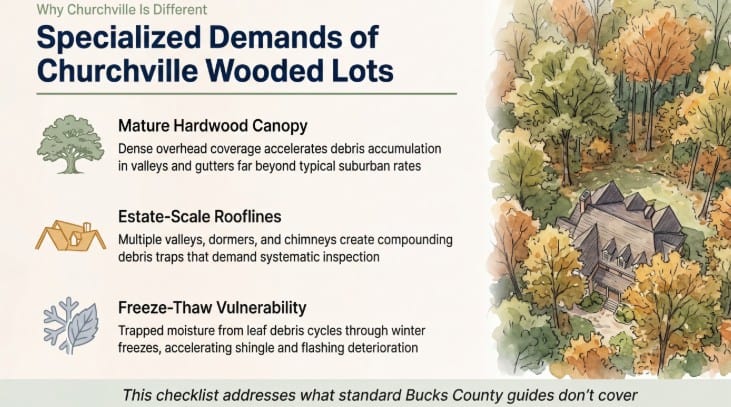
October is the window to identify and address overhanging branches before winter ice and snow loads increase the risk of impact. Any branch within 10 feet of the roof surface should be assessed for removal — particularly large diameter branches directly over valley sections, dormers, or chimneys where a fall would cause disproportionate structural damage. Have an arborist evaluate significant branches; do not attempt to remove large branches yourself above the roofline. DIY difficulty: Low-pitch small branches only. Call an arborist for any branch with a significant diameter or height above the roofline.
6. Skylight and Dormer Flashing Check — October
Estate homes in Churchville often have multiple skylights and dormers — each one a potential leak point if the flashing has deteriorated through the season’s thermal cycling. Check from the interior for any fresh staining at skylight frames or at dormer-to-main-roof wall intersections. Check from ground level with binoculars for lifted or buckled flashing visible at skylight perimeters. Call a pro for any interior staining at skylights or dormers, or any visible displacement of flashing.
7. Attic Moisture Check — October
Before insulation is fully compressed by winter heating patterns, a fall attic inspection is the best opportunity to catch moisture that entered during the summer storm season. Look for dark staining on rafters, soft spots in decking, and any evidence of active daylight through the deck surface. DIY difficulty: Moderate (inspection only). Call a pro for: any staining, soft spots, or daylight findings.
When to Call Paragon Exterior Before Winter
Any evidence of valley damage, chimney flashing separation, moss coverage on aging shingles, interior staining at skylights or dormers, or attic moisture findings warrants a professional visit before Northampton Township’s first hard freeze. Free inspections for all Churchville properties. Call (215) 799-7663.
Frequently Asked Questions
When should I schedule my fall roof inspection in Churchville PA?
Mid-October through November is ideal — after the majority of Northampton Township’s hardwood canopy has dropped its leaves so gutters and valleys can be fully assessed, but early enough to complete flashing repairs before the first hard freeze. On heavily wooded lots, a second light inspection in early December after final leaf drop is also advisable.
How often should I clear debris from my Churchville estate home valleys?
At minimum twice per year — once in late fall after the majority of leaves have fallen, and once in spring after the seed pod and pollen season. On heavily wooded lots with oaks directly overhead, a third clearing in early summer after oak tassels drop is advisable. Valley debris accumulation is the leading cause of accelerated roof aging on Northampton Township wooded-lot properties.
About the Author
Maxwell Martin, CEO, Paragon Exterior LLC
Maxwell Martin has 20+ years of experience in the exterior remodeling industry, specializing in residential and historic roofing across Philadelphia, Bucks County, and the greater Delaware Valley. Paragon Exterior holds PA License #PA197973, GAF certification with access to the Golden Pledge warranty, and a 4.9-star rating across 100+ verified Google reviews.
