
What a Proper Philadelphia Roofing Contractor Estimate Should Include and the Line Items That Prove Quality
Three contractors. Three numbers. No way to tell what each one actually includes. This is the most common experience Philadelphia homeowners have when getting roofing estimates, and it produces one of the most common mistakes: choosing the lowest number without knowing whether all three contractors are pricing the same scope. Choosing a roofing contractor Philadelphia 2026 correctly depends on the ability to compare estimates on equal terms, which requires knowing what a complete estimate must contain and what the missing lines predict about the installation experience.
The 11 Required Line Items in a Philadelphia Roofing Estimate
1. Contractor Name, Physical Address, and PA HIC License Number
Every Pennsylvania home improvement contractor must include their PA HIC (Home Improvement Contractor) registration number on all written estimates and contracts. This is not optional: it is required by the Pennsylvania Home Improvement Consumer Protection Act. A written estimate that does not include the HIC number is either from an unregistered contractor or from one who is not following the legal documentation requirements. Both situations signal the need to ask before proceeding. For more on this, see our guide to Should Expect Roof.
The physical address should be a verifiable office or shop location, not a P.O. box or residential address. Paragon Exterior’s address is 1 Neshaminy Interplex Dr, Suite 103, Feasterville-Trevose, PA 19053. PA HIC License #PA197973. For more on this, see our guide to Brands.
2. Material Manufacturer, Product Line, and Grade
An estimate that says “architectural shingles” without naming the manufacturer and product line is not a material specification. GAF Timberline HDZ and an off-brand architectural shingle both qualify as “architectural shingles.” The performance, warranty, and long-term durability of these products are not equivalent. A written estimate must name the manufacturer (GAF, Owens Corning, CertainTeed, etc.), the specific product line (Timberline HDZ, Duration, Landmark Pro), the grade (if the manufacturer offers multiple tiers), and the selected color. Without this, you cannot verify what was installed after the project completes or make an accurate warranty claim if a material defect appears in year 8. For more on this, see our guide to Premium Roofing Options Popular.
3. Specific Warranty Name and Coverage Duration — Materials and Workmanship Separately
The warranty line in an estimate must name the specific warranty “GAF Golden Pledge” or “GAF System Plus,” for example, state the coverage duration for materials and artistry as separate figures, and identify whether artistry coverage is backed by the manufacturer or solely by the contractor. A line that says “25-year warranty included” without the specific warranty name does not tell you whether the 25 years covers materials only, artistry only, or both, or whether it is manufacturer-backed or contractor-backed.
The Paragon Pre-Installation Assessment Protocol’s Step 7 (Written Scope and Warranty Documentation) requires this level of warranty specificity on every Paragon estimate. The homeowner receives the exact warranty name, the GAF warranty activation process, and confirmation that the system installation was complete enough to activate the full system warranty rather than a partial warranty.
4. Tear-Off Method and Number of Existing Layers
The estimate must state whether the project is a full tear-off to the substrate, a partial tear-off, or an overlay (new material installed over existing). On Philadelphia historic rowhouses with multiple overlay histories, a full tear-off to bare substrate is typically required. The estimate should state the number of existing layers being removed and the tear-off method (Equipter, manual, or dumpster).
A project estimated as an overlay on a two-layer Philadelphia rowhouse is not the same as a full tear-off and new installation, even if the specifications of the installed material are identical. The overlay costs less but yields a shorter service life on a substrate that already has two layers of thermal cycling history.
5. Deck Inspection Protocol and Per-Square-Foot Repair Cost
Every Philadelphia roofing estimate for a home over 20 years old should state: what the contractor will do if deck damage is found during tear-off, the authorization process before additional work proceeds, and the per-square-foot cost for deck repair, if needed. Decking repair runs $2 to $7 per square foot based on Angi’s 2026 Philadelphia cost data.
An estimate that does not address the deck inspection protocol is an estimate from a contractor who plans to call you from the roof with a new number. Paragon Exterior’s deck inspection protocol appears on every estimate: work stops, damage is documented with photographs, the homeowner is contacted before additional work begins, and a written addendum is presented for authorization before any deck repair proceeds.
6. Permit Fee as an Itemized Line
Philadelphia’s Department of Licenses and Inspections requires a permit for roof replacement. The permit fee averages $232, based on the 2026 National Roofing Price Index data for Philadelphia. A legitimate estimate includes the permit fee as a line item and confirms that the contractor pulls and closes the permit as part of the project scope. An estimate that does not mention the permit is from a contractor who is either unaware of the requirement or planning to skip it.
7. Debris Disposal Method
The estimate must specify how tear-off debris is managed: Equipter (debris is captured at the roofline before reaching the ground), dumpster (placed in the street or driveway with a city permit if in the street), or manual haul-out (debris is bagged and carried from the roof to a truck). On Philadelphia row streets where dumpster placement requires a city street permit and where adjacent property access is limited, the debris management method has direct implications for neighbor relations and project logistics.
Paragon Exterior uses the Equipter on Philadelphia rowhouse projects—the magnetic sweep of the property after tear-off completion is included in the stated scope on every estimate.
8. Ice-and-Water-Shield Coverage Depth
Every Philadelphia roofing estimate should state the ice-and-water-shield coverage depth, not just confirm it is “included.” The difference between standard four-foot coverage and the five-foot coverage Paragon specifies on north-facing Philadelphia rowhouse sections is a real installation difference, not a marketing distinction. An estimate that says “ice and water shield included per manufacturer specification” without stating the depth leaves the actual installation coverage up to the crew’s interpretation on the day of installation.
9. Ventilation Specification
Every Philadelphia roofing estimate should include a statement of the ventilation assessment results and the project scope to address ventilation. If the attic inspection found adequate ventilation, the estimate should state that. If ventilation correction is included in scope, the estimate should specify what is being added: ridge vents, soffit baffles, or both, and the target ventilation ratio being achieved. The ventilation standard for Philadelphia’s cold-climate guidelines is a 1:150 ratio of net free area to attic floor area.
10. Timeline with Start Date
The estimate should state the projected start date, the expected project duration in calendar days, and what the contingency is for weather delays: whether the project is rescheduled with priority status, whether temporary protection is installed if the start is delayed after materials are on-site, and how the homeowner is notified of schedule changes. An estimate with no start date is not a scheduled commitment.
11. Payment Terms with Final Payment Contingent on Homeowner Walkthrough
Standard payment terms in Philadelphia roofing are a deposit of 10 to 30 percent to authorize materials ordering, with the balance due upon completion after the homeowner walkthrough. The estimate must state explicitly that the final payment is due after the homeowner walkthrough is completed and the homeowner confirms the work is complete to their satisfaction. Any estimate that requires full payment before work begins or does not include a walkthrough confirmation step is operating outside standard practice in the Philadelphia market.
The 5 Missing Lines That Predict a Problem Later
Missing: Specific warranty name. Predicts: warranty dispute when a claim is attempted, because a “25-year warranty” without a specific name is not a defined warranty obligation.
Missing: Deck inspection protocol. Predicts a mid-project price increase because the contractor plans to discover substrate damage after the tear-off begins rather than before.
Missing: Permit fee. Predicts: either no permit is being pulled, or the homeowner will be asked to pay the permit fee as an additional cost after signing.
Missing: HIC license number. Predicts: contractor is not registered under Pennsylvania’s Home Improvement Consumer Protection Act, which affects their legal accountability and the homeowner’s recourse options.
Missing: Walkthrough confirmation step. Predicts: final payment demand before the homeowner has had the opportunity to identify any installation issues, removing their primary leverage for resolution.
How to Use This Guide to Compare Philadelphia Roofing Estimates
Print this article, or keep it on your phone when reviewing estimates. For each estimate you receive, check all 11 required items. Items that are present and specific (named manufacturer, named warranty, stated HIC number) are credited. Vague items (“quality shingles,” “comprehensive warranty,” “licensed and insured”) are flags that require follow-up questions before committing. Absent items are either items to ask for in writing or items that predict how the project experience will differ from the lowest-price estimate.
Maxwell Martin’s guidance on estimate evaluation: “A homeowner who asks for the warranty name in writing before signing has done most of the contractor qualification work in one question. A contractor who cannot immediately name the warranty they are offering either does not know what they are offering or is offering something less than what they implied. Either answer tells you what you need to know.”
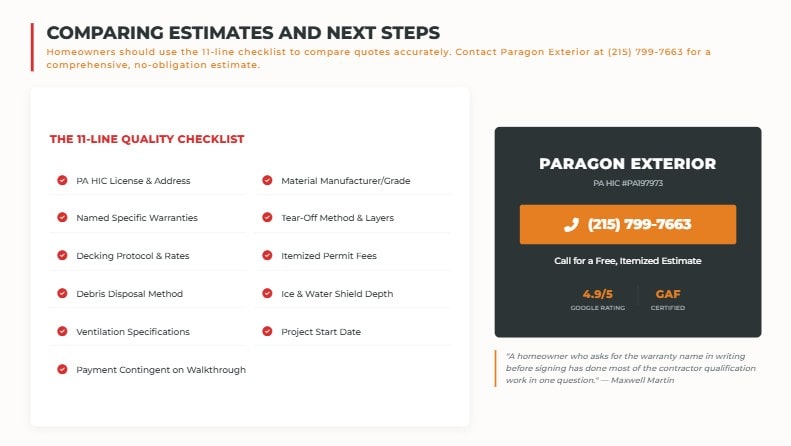
All 11 Line Items Included on Every Paragon Estimate · No Lump-Sum Pricing · PA HIC #PA197973Call (215) 799-7663 — Questions Welcome | Request Online
Frequently Asked Questions: Philadelphia Roofing Estimates
Is a Pennsylvania roofing contractor required to include their HIC number on estimates?
Yes. The Pennsylvania Home Improvement Consumer Protection Act requires all home improvement contractors to include their PA HIC registration number on all written estimates and contracts. An estimate without an HIC number may be from an unregistered contractor. ParagonExterior’s PA HIC License is #PA197973.
How do I compare roofing estimates in Philadelphia when they give different prices?
Estimates are only comparable when they specify the same scope: the same material manufacturer and product line, the same tear-off method, the same warranty name and duration, and the same permit inclusion. A lump-sum estimate cannot be accurately compared to an itemized estimate. Identify which items each estimate includes explicitly and ask any contractor whose estimate is missing items to add them in writing before you decide.
What should the deck repair line say in a roofing estimate?
The deck repair line should state: the process to follow if damage is found (work stops, homeowner is contacted), the authorization requirement before additional work proceeds, and the per-square-foot cost of repair. Decking repair runs $2 to $7 per square foot. A deck repair line that says “any additional deck work will be charged at cost” without a stated rate is not an adequate disclosure of the potential additional cost.
What does the GAF Golden Pledge warranty look like on a written estimate?
A written estimate offering the GAF Golden Pledge will name it specifically: “GAF Golden Pledge Limited Warranty, up to 50 years materials coverage, up to 25 years workmanship coverage backed by GAF.” It will confirm that the complete GAF system installation, using GAF accessories throughout, is specified, as the full system installation is required to activate the Golden Pledge. If an estimate says “GAF shingles with warranty” without these specifics, the warranty being offered is not the Golden Pledge.
How do I schedule a free estimate with Paragon Exterior?
Call (215) 799-7663 or visit paragonexterior.com/estimate. Paragon’s written estimates include all 11 line items described in this article and are scheduled within 24 to 48 hours—no commitment required to receive the estimate. PA HIC License #PA197973, GAF certified, 4.9 stars across 100+ verified Google reviews.
GAF Profile | BBB Profile | BuildZoom
