
Full Roof Replacement Actually Cost in Philadelphia in 2026
The most frustrating part of choosing a roofing contractor Philadelphia 2026 is often the estimate stage: three contractors, three numbers that look nothing alike, no clear way to tell whether the cheapest one is a bargain or a future problem. This guide gives you the cost framework Philadelphia roofing actually operates within in 2026, broken down by every variable that moves the number, so you can evaluate estimates with context rather than guessing.
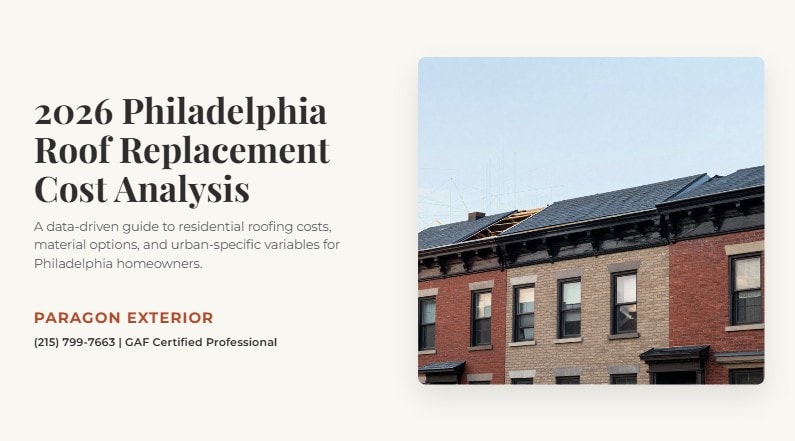
What Philadelphia Roof Replacement Actually Costs in 2026: The Data
InstantRoofer’s April 2026 Philadelphia-specific cost data, based on current contractor pricing inputs and measured roof dimensions across the city, shows the average cost to replace a roof in Philadelphia at $7,210. That figure is calculated on the city’s average residential roof size of approximately 1,016 square feet and the dominant material type: architectural asphalt shingles at $7.10 per square foot installed.
The National Roofing Price Index’s 2026 Philadelphia data provides a different reference point for the architectural shingle segment: a 2,200-square-foot roof costs $11,929 to $16,140, or approximately $637 per roofing square (1 roofing square equals 100 square feet). These two data sources differ because they are measuring different roof sizes, not because the data conflict. Use the InstantRoofer average as a floor for a small rowhouse flat section, and the National Roofing Price Index range as the reference for a full pitched roof replacement on a larger property.
| Material Type | Cost Per Sq Ft (Installed) | 1,000 Sq Ft Total | 2,000 Sq Ft Total | Expected Lifespan |
|---|---|---|---|---|
| 3-Tab Asphalt Shingles | $3.43 – $4.65 | $3,430 – $4,650 | $6,860 – $9,300 | 15 – 20 years |
| Architectural Asphalt Shingles | $4.11 – $7.10 | $4,110 – $7,100 | $8,220 – $14,200 | 25 – 35 years |
| Metal (Standing Seam) | $18.00 – $24.50 | $18,000 – $24,500 | $36,000 – $49,000 | 40 – 70 years |
| Modified Bitumen (flat/rear addition) | $3.50 – $4.50 | $3,500 – $4,500 | $7,000 – $9,000 | 15 – 20 years |
| Slate (natural) | $15.00 – $30.00+ | $15,000 – $30,000+ | $30,000 – $60,000+ | 75 – 150 years |
Per-square-foot ranges reflect Philadelphia-area installed costs as of April 2026. Sources: InstantRoofer Philadelphia April 2026, National Roofing Price Index 2026, Angi Philadelphia cost data, roofingcalculator.com 2026. Final project cost depends on roof size, configuration, access conditions, and substrate findings after tear-off.
The Philadelphia City Premium: Why Your Roof Costs More Than the National Average
Every national cost calculator starts with a per-square-foot material cost and applies a labor multiplier. What those calculators typically do not build in are the Philadelphia-specific cost factors that apply to virtually every city roofing project. These are not hidden fees. They are real project costs that a legitimate contractor includes in the written estimate. If your estimate does not show them, they will appear later.
Labor rate premium. Philadelphia contractor labor runs $250 to $450 per roofing square, compared to $200 to $350 per square in the surrounding suburban counties of Montgomery, Bucks, Delaware, and Chester. The premium reflects the logistics of urban roofing: tight access on row streets, no-parking zone management, and the additional staging and debris management required on properties where a dumpster truck cannot park at the roofline.
Permit fees. Philadelphia’s Department of Licenses and Inspections requires a permit for roof replacement. The National Roofing Price Index’s 2026 Philadelphia data shows the average permit fee at $232. On larger commercial or complex residential projects, the fee scales with project value. This is a legitimate project cost that should appear as a line item on any honest estimate.
Debris disposal. On Philadelphia rowhouses without side yard or driveway access, debris management during tear-off requires specialized equipment or labor coordination. Paragon Exterior uses an Equipter, a self-propelled debris container that positions at the roofline and captures tear-off material before it reaches the street or adjacent properties. This prevents liability and neighbor-relationship problems from debris landing on adjacent properties, and it adds a modest cost premium over a truck-bed haul-away approach.
Two-surface replacement. Most Philadelphia rowhouses have both a pitched main section and a flat rear addition. A complete replacement covering both surfaces requires two membrane systems: architectural shingles for the pitched section and modified bitumen or TPO for the flat section. Both surfaces need to be addressed in the same project if the flat section is also at or approaching the end of service life, because water infiltration from either surface can compromise both substrates over time.
What Adds to the Base Estimate: Hidden Costs That Aren’t Hidden If You Ask
The cost elements below are not genuinely hidden. They are predictable conditions that contractors who do a thorough inspection identify and document before the estimate is written. The difference between a contractor who surprises you with these costs at tear-off and one who does not is the presence or absence of a pre-installation assessment protocol that inspects for them in advance.
Decking replacement. Philadelphia rowhouses built before 1960 frequently have original board sheathing or early-generation plywood beneath multiple layers of overlay. After 60 to 100 years, soft spots in north-facing valleys and areas of historical water infiltration are common. Decking repair costs $2 to $7 per square foot of damaged area based on Angi 2026 data. On the Langhorne Victorian project, Paragon Exterior documented that 12 OSB replacement sheets were required in three valley areas. That additional scope was identified before the estimate was written, not discovered during the tear-off.
Chimney reflashing. Original lead chimney flashing on Philadelphia historic homes is often at or past service life by the time the roof system is being replaced. Lead-coated copper reflashing appropriate to a historic property runs $800 to $2,000, depending on chimney size and configuration. Standard aluminum flashing is cheaper but less appropriate for historic district properties and less durable over a 25- to 30-year service life.
Ventilation upgrades. Philadelphia rowhouses built before modern ventilation standards frequently have inadequate soffit-to-ridge airflow. Adding ridge vents and replacing deteriorated soffit baffles adds $400 to $1,200 to the project cost but extends the expected life of the new roof system. Maxwell Martin has noted in Paragon Exterior’s published case documentation that ventilation upgrades on the Langhorne Victorian extended the expected roof life by an estimated 3 to 5 years beyond that of the deficient system that was replaced.
Historic district compliance. Properties in Philadelphia Historical Commission-designated districts require PHC material approval before L&I will issue a permit. This does not typically add direct cost, but it adds 3 to 4 weeks to the project timeline, and some material selections require specification review that can change the material cost if the originally specified product is not PHC-approved for the specific property.
The Estimate Structure That Protects You
The Paragon Pre-Installation Assessment Protocol’s final step, Step 7 (Written Scope and Warranty Documentation), defines what a legitimate estimate must contain. The difference between an estimate that protects you and one that does not is the level of specificity in the written document.
A legitimate estimate for a Philadelphia roof replacement names the manufacturer and product line (not just “architectural shingles”), states the warranty name and coverage duration separately for materials and workmanship, lists the tear-off method (full tear-off to substrate, not overlay), states the deck inspection protocol and the cost basis if damage is found, itemizes permit fees, describes the debris management method, states the start date and projected duration, and specifies payment terms with final payment contingent on homeowner walkthrough completion.
An estimate that gives you a single number without this information is not comparable to an estimate that includes it. Two estimates, where one says “full roof replacement: $10,500” and another says “GAF Timberline HDZ in Charcoal, full tear-off to substrate, L&I permit included, GAF Golden Pledge warranty covering 25 years workmanship, deck inspection protocol, Equipter debris management, $11,800” are not competing on the same dimension. The first estimate cannot be evaluated because you do not know what you are buying.
The Seasonal Price Window: When to Schedule for Best Availability and Pricing
Philadelphia roofing has two peak booking windows: May through June and September through October. During these windows, contractors’ schedules fill 4 to 6 weeks in advance, and scheduling flexibility is limited. According to the 2026 Philadelphia cost guide published by EastCoastRoofingGuide, off-season replacements in late winter or mid-summer can sometimes earn 5 to 10 percent pricing flexibility if the crew has open days.
Installation temperature matters: most architectural shingle products require ambient temperatures above 40-50 degrees Fahrenheit for proper sealant activation. Philadelphia winters regularly drop below this threshold from December through February. Cold-weather installation requires hand-sealing techniques and manufacturer-specified cold-weather procedures, which add labor time and should be documented in the installation spec.
If your roof has an active leak or storm damage, the season does not drive your scheduling decision. Contact Paragon Exterior at (215) 799-7663 for a prioritized response to active damage situations, which are scheduled regardless of the season.
GAF Certified · 4.9 Stars / 100+ Reviews · No Lump-Sum PricingCall (215) 799-7663 — Questions Welcome | Request Online
Frequently Asked Questions: Roof Replacement Cost in Philadelphia 2026
What is the average cost to replace a roof in Philadelphia in 2026?
The average Philadelphia roof replacement cost is $7,210, based on InstantRoofer’s April 2026 data, calculated using the city’s average roof size of approximately 1,016 square feet and the use of architectural asphalt shingles. For a historic rowhouse with a full-pitched section and rear flat addition, full replacement of both surfaces typically runs $11,000 to $18,000, depending on material grade, access conditions, and substrate findings.
Why is roof replacement more expensive in Philadelphia than in the suburbs?
Philadelphia contractor labor costs $250 to $450 per roofing square, compared with $200 to $350 in surrounding suburban counties. The city premium reflects row-home access complexity, no-parking-zone management, higher permit fees (average $232), and debris-disposal costs in dense urban blocks. These are real project costs, not contractor markups, and they should appear as itemized line items in any written estimate.
How much does deck replacement add to a Philadelphia roof project?
Decking repair costs $2 to $7 per square foot of damaged area based on Angi 2026 data. A 100 square foot soft-decking section at a north-facing valley adds $200 to $700 to the project. On older Philadelphia rowhouses, the Paragon Pre-Installation Assessment Protocol’s attic assessment step identifies soft-decking areas before tear-off begins, so the potential additional cost is documented in the estimate rather than disclosed after work has started.
How do I accurately compare roof replacement estimates in Philadelphia?
Estimates are only comparable when they specify the same information: material manufacturer and product line, tear-off method, permit handling, deck inspection protocol, and warranty terms by name. A lump-sum estimate without material specification cannot be accurately compared to an itemized estimate. The lower lump sum may result from using lower-grade materials, skipping the permit, or excluding items that the itemized estimate explicitly includes.
What financing options are available for a roof replacement in Philadelphia?
Paragon Exterior offers financing options for qualifying projects. Roof replacement also qualifies for homeowner’s equity financing through most lenders, and homeowners with storm-damaged roofs may qualify for insurance coverage that eliminates or substantially reduces the out-of-pocket cost. Discuss financing and insurance documentation during your free estimate appointment. Call (215) 799-7663 or visit paragonexterior.com/estimate to schedule.
GAF Profile | BBB Profile | BuildZoom
