
Asphalt Shingles vs. Metal Roofing for Philadelphia Rowhouses
Which Material Lasts Longer in Freeze-Thaw?
Philadelphia homeowners considering a roof replacement face a material decision that national guides consistently get wrong for this specific market. Choosing a roofing contractor Philadelphia 2026 for a historic rowhouse begins with understanding which material is actually right for the property’s construction era, climate exposure, and historic district requirements — not which material is trending nationally.
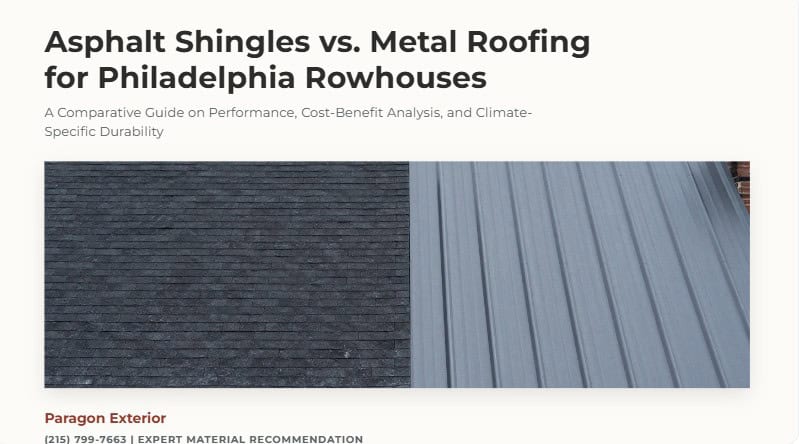
The Philadelphia Freeze-Thaw Variable: Why It Changes the Comparison
Philadelphia averages approximately 100 freeze-thaw cycles per year. Each cycle contracts and expands every sealed joint in the roofing system: shingle sealant strips, flashing terminations, valley metal sealant, and ridge cap adhesive. A material that performs well in a warmer climate with fewer annual thermal cycles may perform differently under 100 annual cycles of mechanical stress over a 25-year roof life (approximately 2,500 total cycles).
For architectural asphalt shingles, the critical performance variable in Philadelphia’s freeze-thaw climate is the integrity of the sealant strip. Architectural shingles use a heat-activated sealant that bonds shingles to the course below. In Philadelphia’s freeze-thaw cycling, this sealant bond is repeatedly stressed. A properly installed architectural shingle, correctly nailed in the nail zone and allowed to thermally seal before the first winter cycle, will maintain its bond through Philadelphia’s climate. A shingle that was improperly nailed or installed below the manufacturer’s temperature minimums will fail at the sealant strip within two to five winters.
For standing seam metal, the critical variable is thermal expansion management. Metal roofs expand and contract with temperature far more than asphalt shingles. Standing seam profiles are engineered with floating clip systems that allow the metal panels to move without the movement stressing the fasteners or creating gaps. A metal roof installed with fixed clips or insufficient expansion allowance will lead to fastener stress failures and noise issues within a few seasons. Metal’s longevity advantage (40 to 70 years versus 25 to 35 years for architectural shingles) is realized only when installation properly accounts for thermal movement.
Cost Comparison: 30-Year Horizon
Comparing asphalt shingles and standing-seam metal based on installed cost alone misframes the decision. The relevant comparison is the cost per year of protection over the ownership horizon.
Architectural asphalt shingles installed at $4 to $7 per square foot on a 1,500 square foot Philadelphia rowhouse pitched section: $6,000 to $10,500 installed, with a 25-to-35-year lifespan. At 30 years, two replacement cycles are likely needed. Two installations at $8,000 each: $16,000 over 30 years, or approximately $533 per year.
Standing seam metal at $18 to $24 per square foot on the same 1,500 square feet: $27,000 to $36,000 installed, with a 40-to-70-year lifespan. At 30 years, no replacement cycle is needed. Total cost: $27,000 to $36,000, or $900 to $1,200 per year over 30 years.
Over a 30-year horizon for a typical rowhouse pitched section, standing-seam metal is actually more expensive per year of protection than two cycles of architectural shingles. The 30-year comparison only reverses in metal’s favor when the horizon extends to 50 to 60 years, when metal requires zero replacement and asphalt requires three or four cycles.
Historic District Compatibility
Philadelphia Historical Commission design review guidelines address roofing materials for properties in designated historic districts. Modern architectural asphalt shingles in dimensional profiles and period-appropriate colors are regularly approved for historic district properties. The GAF Timberline HDZ in Charcoal, specified for the Langhorne Victorian replacement documented in Paragon Exterior’s published case studies, was selected specifically for its compatibility with the Victorian-era roofline character while meeting contemporary performance standards.
Standing-seam metal has historical precedent in Philadelphia architecture, as documented in the City of Philadelphia’s Rowhouse Manual. Copper and tin-plate metal roofs were historically common on 19th-century properties in Philadelphia. Modern standing seam profiles in appropriate colors are often approvable in historic districts, but the approval process requires PHC review and may take 3 to 4 weeks. Paragon Exterior manages this process as part of the Permit and Compliance Mapping step in the Paragon Pre-Installation Assessment Protocol for historic district projects.
When Each Material Is the Right Answer
Architectural asphalt shingles are the right answer when: the project budget is $8,000 to $16,000, the ownership horizon is 10 to 25 years, the property is in a historic district where metal approval timelines would delay the project, or the property has complex chimney and dormer configurations where asphalt’s flexibility at detail points outperforms metal’s expansion management requirements.
Standing seam metal is the right answer when: the homeowner plans to remain in the property for 40+ years, the energy efficiency premium from the reflective surface is a material factor in the decision, the property has a simpler roofline configuration that supports metal’s expansion system requirements, and the budget supports the higher installation cost. Metal is also the right answer for rear flat additions on high-end restoration projects where the architectural aesthetic consistency of metal throughout the property is the priority.
Maxwell Martin’s assessment: “For most Philadelphia rowhouses, architectural shingles with a GAF Golden Pledge warranty are the right recommendation. The freeze-thaw performance gap between asphalt and metal is largely eliminated when asphalt is installed in accordance with factory specifications. What we consistently see is that the difference in a Philadelphia rowhouse is not asphalt versus metal—it is correctly installed asphalt versus incorrectly installed asphalt. The best architectural shingle system installed lasts 30 to 35 years in Philadelphia. The same product installed at 80 percent of the specification fails in 12 to 15.”
The Flat Addition: Modified Bitumen Remains the Standard
The rear flat addition on most Philadelphia rowhouses is not a candidate for asphalt shingles or standing seam metal. Modified bitumen remains the correct system for flat and low-slope surfaces: torch-applied seam adhesion that performs reliably through Philadelphia’s freeze-thaw cycles, adequate drainage at interior drains, and a 15-to-20-year lifespan appropriate to the replacement cycle. TPO offers a longer lifespan (20 to 30 years) for larger commercial-scale flat surfaces at a higher per-square-foot cost. For a standard rowhouse rear addition of 200 to 500 square feet, modified bitumen is the dominant recommendation.
Free Inspection · GAF Certified · Written Estimate Including Material JustificationCall (215) 799-7663 — Questions Welcome | Request Online
Frequently Asked Questions: Asphalt vs Metal for Philadelphia Rowhouses
Which roofing material lasts longer in Philadelphia’s freeze-thaw climate?
Standing seam metal lasts 40 to 70 years in Philadelphia when correctly installed with proper expansion management, versus 25 to 35 years for architectural asphalt shingles. However, the longevity advantage of metal requires proper management of thermal movement during installation. Both materials perform well in Philadelphia’s freeze-thaw climate when properly installed. The larger performance gap in Philadelphia is between correctly and incorrectly installed asphalt, not between asphalt and metal.
Can I install standing-seam metal on a rowhouse in the Philadelphia historic district?
Metal roofing has historical precedent in Philadelphia architecture and is often approvable in PHC historic districts in appropriate profiles and colors. The approval process requires PHC review and typically takes 3 to 4 weeks. Paragon Exterior manages PHC review as part of the standard scope on historic district projects.
What is the cost difference between asphalt shingles and metal roofing in Philadelphia?
Architectural asphalt shingles run $4 to $7 per square foot installed on a pitched roof in Philadelphia. Standing seam metal runs $18 to $24 per square foot installed. On a 1,500-square-foot pitched section, the upfront cost gap is approximately $19,000 to $26,000 for metal, with no replacement needed for 40 to 70 years, versus two replacement cycles for asphalt over the same period.
How do I schedule a material recommendation consultation with Paragon Exterior?
Call (215) 799-7663 or visit paragonexterior.com/estimate. The free estimate includes a written material recommendation with the specific justification for your property’s configuration, historic district requirements, and budget parameters. Scheduled within 24 to 48 hours.
GAF Profile | BBB Profile | BuildZoom
