
How to Spot Storm Chaser Roofing Contractors in Philadelphia
Protect Yourself from Post-Storm Fraud
After every significant storm event in Philadelphia, two things happen simultaneously: legitimate local contractors get busier, and out-of-market contractors who were never in the area before the storm arrive and start knocking on doors. Choosing a roofing contractor Philadelphia 2026 after a Nor’easter or major hail event requires recognizing the specific behavioral markers that distinguish storm chasers from contractors with a legitimate stake in the city’s roofing market. The behavioral pattern is consistent enough to be read within the first two minutes of the interaction.
Why Philadelphia Attracts Storm Chasers After Nor’easters
Philadelphia’s dense residential housing stock, the prevalence of older homes with roofing systems nearing or at the end of their service life, and the high rate of homeownership in the city and surrounding suburbs make it a high-value market for contractors who follow storm events, seeking insurance-funded work. Nor’easters, which produce both wind uplift damage to shingles and flashing and ice damage to valleys and eaves, are the primary trigger event. Summer hail events also attract post-storm canvassing, particularly in the northern Philadelphia suburbs of Bucks and Montgomery Counties.
Storm chasers operate on a high-volume, low-relationship model: collect as many signed “direction to pay” agreements as possible in the 48 to 96 hours after a storm, process the insurance claims centrally, perform installations with subcontract crews at below-market material quality, and move to the next storm market before warranty claims arrive. The homeowner who signed the direction-to-pay agreement is left with a contractor who is no longer in the Philadelphia area when the installation issues appear 18 to 36 months later.
The 8 Behavioral Markers of a Philadelphia Storm Chaser Contractor
1. Door-to-door canvassing within 24 to 72 hours of a storm event. Legitimate local contractors do not need to knock on doors in the days after a storm. Their phones are already ringing from established clients, referrals, and Google searches from homeowners who found them through their documented local presence. A contractor who knocks on your door has no prior relationship with your neighborhood and is there specifically because of a storm event.
2. Request for a signed document before the inspection is complete. Any contractor who asks you to sign anything before they have completed a written inspection and delivered a written estimate is asking you to commit before you have evaluated what you are committing to. The document they want you to sign is most often a “direction to pay,” “assignment of benefits,” or “authorization to proceed” form that transfers your insurance proceeds to the contractor. Once signed, this document is enforceable regardless of the quality of the work that follows.
3. No Pennsylvania physical business address. Ask for the physical business address and search it. A contractor who lists a residential address, a P.O. box, or an address in another state has no fixed local presence in Pennsylvania. A legitimate Philadelphia-area contractor has a verifiable office or shop location that has been in the same place for more than 48 hours.
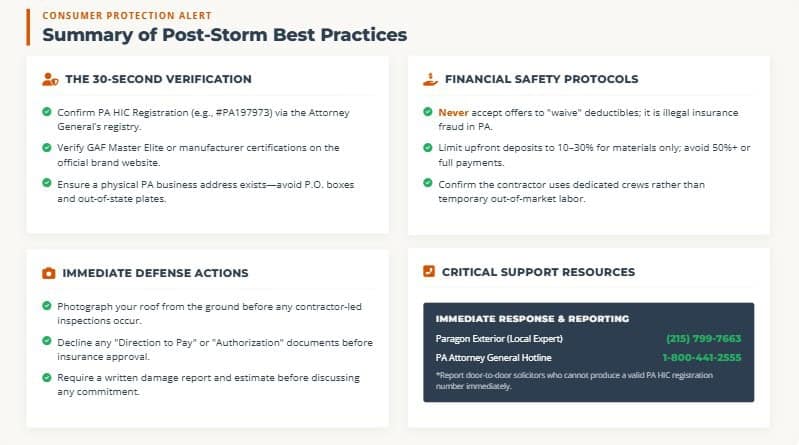
4. No Pennsylvania HIC registration number. Pennsylvania requires all home improvement contractors to register under the Home Improvement Consumer Protection Act before accepting any home improvement work. Ask for the contractor’s Pennsylvania HIC number. A contractor who cannot produce it on request is operating outside legal requirements. Paragon Exterior’s PA HIC License is #PA197973, which is verifiable on the Pennsylvania Attorney General’s contractor registry. Any legitimate contractor can produce their number immediately.
5. Pressure to sign before your insurance claim is filed or approved. Your insurance claim does not require a contractor agreement to be filed. The claim requires documentation of the damage: photographs, a written inspection report, and a contractor estimate. Signing a direction-to-pay before filing is not a required step in the claims process. A contractor who tells you otherwise is misstating the process for their benefit, not yours.
6. Request for a large upfront payment. Standard roofing contract practice in Philadelphia involves a deposit of 10 to 30 percent to order materials, with the balance due upon project completion and homeowner walkthrough sign-off. A contractor requesting 50 percent or full payment upfront before any work begins is operating outside standard practice. BBB records on contractor fraud complaints consistently show large upfront payment requests as a primary pattern.
7. Offer to waive your insurance deductible. Under Pennsylvania law, a contractor who offers to waive, absorb, or rebate a homeowner’s insurance deductible as an inducement to sign is engaged in insurance fraud. This offer, which storm chasers frequently use as a sales tool, violates Pennsylvania’s unfair insurance practices regulations and also exposes the homeowner to liability for fraud. If a contractor offers to waive your deductible, that offer is a disqualifying signal.
8. Unable to produce a verifiable manufacturer certification profile URL. Any contractor who claims GAF certification can be verified at gaf.com. Search by contractor name and state. If the contractor claims Master Elite certification, the designation should appear on their profile. If they cannot provide a GAF profile URL or their name does not appear in the GAF contractor directory, the certification claim is inaccurate. Paragon Exterior’s GAF profile is publicly accessible and verifiable at the GAF contractor directory.
The Direction-to-Pay Document: What It Is and Why You Should Not Sign It Until Your Claim Is Approved
The “direction to pay” document, also called “assignment of benefits” in some states, authorizes your insurance company to send claim proceeds directly to the contractor rather than to you. Once signed, the contractor has direct access to your insurance payout.
Storm chasers use this document because it converts an uncertain outcome (whether the homeowner will ultimately hire them) into a certain financial commitment. Once you have signed, the contractor has a legal claim to your insurance proceeds. If the claim is approved for $12,000 and you later decide you do not want to proceed with that contractor, you may have a legal obligation to them regardless.
A legitimate contractor does not need a direction-to-pay document signed before your claim is approved. They inspect, document the damage, provide a written estimate, and wait for you to review the claim outcome before any payment document is signed. The direction-to-pay or similar authorization is a legitimate document at the right stage: after the claim is approved and you have decided to proceed. It is a problem at the pre-claim stage.
What to Do When a Storm Chaser Knocks on Your Door in Philadelphia
You are not obligated to let any contractor onto your roof or into your home. If a contractor arrives door-to-door after a storm:
Ask for their name, business name, and Pennsylvania HIC number. If they cannot provide all three immediately, thank them and close the door.
Do not let anyone onto your roof who you have not verified meets the Pennsylvania registration requirement and can provide a verifiable local business address.
Photograph your own roof condition from the ground before any inspection visit. Your pre-inspection documentation protects you against a contractor who might misrepresent conditions found during their inspection.
Contact a local contractor you have verified through the Pennsylvania AG contractor registry, GAF contractor directory, or your own neighborhood referral network. Paragon Exterior’s team is available at (215) 799-7663 for storm damage inspections. Active storm damage situations receive prioritized scheduling.
Maxwell Martin’s direct guidance: “A legitimate contractor does not knock on your door after a storm. They have established clients, referral partners, and a documented local reputation that generates more work than a residential canvassing route could match. If someone is working in the neighborhood after a storm, their business model depends on finding homeowners who do not know what to ask for. The questions are simple: Can you show me your PA HIC number? Can you show me your GAF profile? Both of those answers take 30 seconds. A contractor who cannot answer them in 30 seconds has told you everything you need to know.”
After the Storm: Paragon Exterior’s Process for Legitimate Storm Damage Inspection
Paragon Exterior’s storm damage inspection follows the Paragon Pre-Installation Assessment Protocol’s standard seven-step methodology, with emphasis on Step 2 (Surface and System Inspection) and storm-specific documentation for the insurance process.
The inspection documents: all storm-caused damage visible from the roof (impact patterns consistent with hail, wind-lifted shingles, flashing separations, debris damage), the extent of pre-existing conditions that are not storm-caused (which the homeowner needs to know to understand what insurance will and will not cover), and photographs in the format insurance adjusters require.
The written inspection report and estimate are delivered before any discussion of payment authorization. No direction-to-pay or similar document is presented until the homeowner has reviewed the claim decision and chosen to proceed with Paragon Exterior as their contractor.
PA Licensed · GAF Certified · No Pressure to Sign · Prioritized Scheduling for Active Damage Call (215) 799-7663 — Available for Storm Response | Request Online
Frequently Asked Questions: Storm Chasers in Philadelphia
Is it illegal for a roofing contractor to offer to waive my insurance deductible in Pennsylvania?
Yes. Under Pennsylvania’s unfair insurance practices regulations, a contractor who offers to waive, absorb, or rebate a homeowner’s insurance deductible as an inducement to sign a contract violates Pennsylvania insurance law. This offer is a disqualifying marker that should end the conversation with that contractor immediately.
What is a direction-to-pay document, and should I sign one after a storm?
A direction-to-pay document authorizes your insurer to send claim proceeds directly to the contractor. It creates a legal claim on your insurance payout. Do not sign it before your claim is approved and you have decided to proceed with a specific contractor. A legitimate contractor does not require it before claim approval.
How do I verify a Philadelphia roofing contractor’s Pennsylvania registration?
Search the Pennsylvania Attorney General’s Home Improvement Contractor registry. Enter the contractor name or their claimed HIC number. Paragon Exterior is registered at PA HIC License #PA197973. Any contractor who cannot provide their HIC number on request is not legally registered to perform home improvement work in Pennsylvania.
What should I do if I have already signed a document with a storm chaser contractor?
Contact the Pennsylvania Attorney General’s consumer protection division and document everything you signed and all communications with the contractor. Under Pennsylvania’s Home Improvement Consumer Protection Act, home improvement contracts include a three-day cancellation right after signing, which gives you a window to rescind. Consult with a Pennsylvania consumer protection attorney for guidance specific to your situation. The Pennsylvania Office of Attorney General’s consumer protection hotline is 1-800-441-2555.
How do I schedule a storm damage inspection with Paragon Exterior?
Call (215) 799-7663. Active storm damage situations are prioritized for same-day or next-day response when scheduling permits. Free inspection, written damage report in insurance adjuster format, no pressure to sign any document until the claim decision is reviewed. PA HIC License #PA197973, GAF certified, 4.9 stars across 100+ Google reviews.
GAF Profile | BBB Profile | BuildZoom
