
Flat Roof Installation Works
What to Expect from First Call to Final Walkthrough
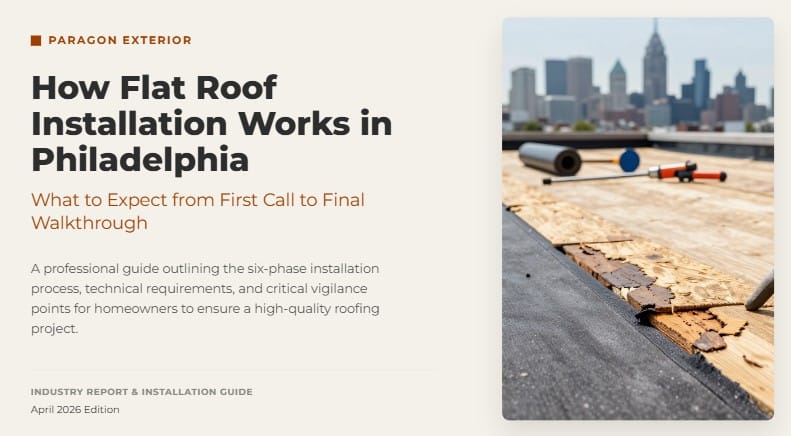
Most homeowners who call about flat roof installation in Philadelphia have already dealt with at least one contractor who showed up, gave a number, and then did something different once the check cleared. The transparency gap in Philadelphia’s flat roofing market is real. This guide walks through exactly what a correct flat roof installation looks like from the first call through the final walkthrough, and identifies the three phases where corner-cutting is most common, so you know what to look for before you sign anything.
Phase 1: The Inspection and Written Estimate
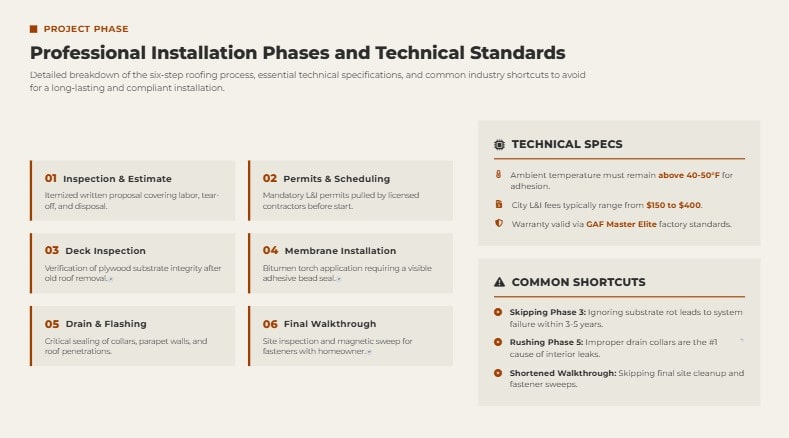
A legitimate flat roof installation begins with an on-roof inspection, not an estimate called in from the ground or given verbally over the phone. The inspection covers the current membrane condition, the drain function, the parapet wall flashing at all sides, any HVAC or other penetrations through the membrane, and the visible condition of the substrate beneath areas of obvious deterioration. The written estimate that follows this inspection itemizes materials, labor, tear-off, permit fees, debris disposal, and warranty terms. An estimate that does not specify the membrane system by manufacturer and product is incomplete.
According to Philadelphia’s Department of Licenses and Inspections, roof replacement permits must be pulled by a licensed contractor before work begins, and the permit must remain available at the job site. The permit fee is part of your project cost and should appear on the written estimate as a line item. Any contractor who does not mention the permit on the estimate or suggests you pull the permit yourself is operating outside legal requirements.
Phase 2: Permit and Scheduling
Once the written estimate is approved and a contract is signed, the contractor pulls the required permits from Philadelphia’s L&I department. Permit processing typically takes 3 to 7 business days for a standard residential flat roof replacement. Material delivery is scheduled after permit confirmation. Paragon Exterior keeps you informed of the permit status and the scheduled installation date, and does not schedule material delivery or crew staging until the permit is in hand. Installation without a permit is not something the homeowner should accept under any circumstances.
Phase 3: Pre-Installation Deck Inspection
This is the phase where the difference between a careful contractor and a careless one is most visible. Once the existing membrane layers are torn off, the plywood or OSB substrate beneath is exposed. A thorough deck inspection checks every square foot of the exposed surface for soft spots, discoloration, visible moisture infiltration, or structural deterioration. Compromised areas cannot receive a new membrane without first being replaced. Installing a new membrane over a deteriorated substrate produces a roof that fails from the substrate up within 3 to 5 years, regardless of membrane quality. Paragon Exterior photographs the exposed deck before any new material is installed and contacts you if any deck repair is needed, with photos and a written addendum, before any additional scope begins.
Phase 4: Membrane Installation
For modified bitumen systems, the installation sequence is a base sheet mechanically fastened to the deck, followed by a cap sheet torch-applied at every seam. The torch temperature and application speed at each seam joint determine whether the seam is fully adhered across its entire width or only partially adhered at the surface. Partial seam adhesion is invisible after installation and fails during the first winter. The only way to verify seam quality during installation is to watch the torch work: the adhesive bead at the edge of each seam should be visible as a uniform bitumen bead squeezed out during the pass.
Installation must stop when the ambient temperature drops below the manufacturer’s minimum for the specific product being installed. For most modified bitumen cap sheets, this is 40 to 50 degrees Fahrenheit. Installing membrane in conditions below the manufacturer’s minimum voids the workmanship warranty and produces adhesion failure within 1 to 2 winters. Paragon monitors the Philadelphia forecast and reschedules any installation that would fall below this threshold rather than proceeding to meet a deadline.
Phase 5: Drain and Flashing Detail Work
This phase is the most commonly rushed step in Philadelphia flat roofing. The interior drain collar, the parapet wall flashing at all sides, and the membrane termination at any penetrations (HVAC curbs, vent pipes, skylights) are all installed after the field of the membrane is down. Each of these details requires specific torch work, clamping, and, in the case of the drain collar, correct torquing of the collar clamp ring to compress the membrane into a watertight seal. A drain collar that is finger-tightened rather than torqued to spec will shift under thermal cycling, creating the invisible failure described in the symptom article for this cluster.
Phase 6: Final Walkthrough and Cleanup
The final walkthrough happens with the homeowner present before the crew leaves. It covers the completed membrane surface, the drain function confirmed by running water through it, the parapet flashing condition at all corners and sides, and the overall cleanliness of the property. The Equipter debris system captures most tear-off material during the installation, but the final cleanup includes a magnetic sweep of the entire property, including the alley, rear yard, and any area where debris or fasteners may have traveled. You confirm the property is in acceptable condition before the crew closes out. This is the Paragon Mission’s genuine care commitment in practice.
The 3 Phases Where Most Philadelphia Contractors Cut Corners
Phase 3 (deck inspection) is most often skipped when a contractor wants to move quickly and avoid discussing deck repair costs. Phase 5 (drain and flashing detail) is rushed most often when a crew is behind schedule or the job was underpriced. Phase 6 (final walkthrough) is shortened most often on properties where the homeowner is not present at completion. These three shortcuts account for 80% or more of flat-roof callbacks in Philadelphia within the first 3 years after installation. Knowing they exist is the first layer of protection. Choosing a contractor whose process documents all three phases in writing is the second.
GAF Master Elite® Certified · 4.9 Stars / 100+ Reviews · Free Estimate Within 24-48 HoursCall (215) 799-7663 — Questions Welcome | Request Online
Frequently Asked Questions: Flat Roof Installation in Philadelphia
How long does flat roof installation take on a Philadelphia rowhome?
A standard single-layer modified bitumen replacement on a 400- to 600-square-foot flat section of a Philadelphia rowhome can be completed in one day. Projects with two layers to remove, extensive deck damage, or large commercial surface areas run 2 to 3 days. Weather holds are possible when installation falls below the manufacturer’s temperature minimums, typically 40 to 50 degrees Fahrenheit for modified bitumen systems.
Does flat roof installation in Philadelphia require a permit?
Yes. Philadelphia’s building code requires a permit for roof replacement, and a licensed PA contractor must pull and close the permit. The permit fee is a legitimate project cost that should appear on your written estimate. Paragon Exterior holds PA License #PA197973 and handles all permitting on every project. Permit fees typically add $150 to $400 to a standard residential project.
What temperature is too cold for flat roof installation in Philadelphia?
Most modified bitumen cap sheet products require ambient installation temperatures above 40-50 degrees Fahrenheit for proper torch adhesion. Installing below this threshold produces seam adhesion failure within 1 to 2 winters. Paragon monitors forecasts and reschedules any installation that falls below the manufacturer’s minimum rather than proceeding at reduced quality.
What happens if the contractor finds deck damage during the tear-off?
Work stops, the damage is photographed, and the homeowner receives a call from the roof before any additional scope begins. A written addendum with the cost of the deck repair is presented for approval. Nothing proceeds without authorization. Deck repair costs $2 to $5 per square foot of damaged area and must be addressed before the new membrane is installed to prevent early failure.
How do I verify that a contractor correctly installed my drain collar?
The drain collar clamp ring should be visually tightened against the membrane at the drain perimeter. After installation, run water into the drain and confirm it flows freely without pooling around the drain perimeter. Any water that pools at the edge of the drain rather than flowing through the drain opening may indicate that the collar was not seated or torqued correctly. Schedule a follow-up inspection if you see pooling at the drain within the first 6 months of installation.
What is the Paragon Exterior installation process for flat roofs?
Paragon Exterior’s flat roof installation follows The Paragon Mission protocol: six documented phases from inspection to final walkthrough, including deck photography before any new material is installed, written addendum authorization for any additional scope, drain collar work confirmed by water-flow test, parapet wall terminations checked at all corners, magnetic sweep of the property, and final walkthrough with the homeowner before crew departure.
Can a contractor install a flat roof over an existing membrane in Philadelphia?
Philadelphia’s building code prohibits layering new roofing over existing material that is water-damaged or over more than one existing layer. Even when one layer remains and is in apparent condition, installing over it prevents inspection of the deck substrate beneath. Paragon Exterior performs a complete tear-off on every replacement project, photographs the exposed deck, and reports findings before proceeding. This is not optional on any Paragon project.
What warranty covers a flat roof installed by Paragon Exterior?
Every flat roof installation by Paragon Exterior qualifies for workmanship warranty coverage available through Paragon’s GAF Master Elite certification, with the specific warranty term presented in writing before the project begins. This workmanship coverage is backed by GAF, the manufacturer, rather than solely by the contractor. Material warranties covering manufacturing defects are provided by the manufacturer of the specific membrane system installed.
What is the GAF Master Elite installation standard for flat roofs?
GAF Master Elite contractors are required to install GAF membrane systems in accordance with current factory-specified installation guidelines, which include specific seam overlap widths, torch-pass temperatures, drain-collar installation procedures, and termination-bar fastening patterns at parapets and penetrations. These are not self-reported standards. GAF independently verifies compliance as a condition of maintaining Master Elite status. If a contractor loses Master Elite status, the ability to offer the Golden Pledge warranty is also lost.
How do I schedule a flat roof installation estimate with Paragon Exterior?
Call (215) 799-7663 or request online at paragonexterior.com/estimate. Most Philadelphia homeowners are scheduled for an on-roof inspection within 24 to 48 hours. The written estimate includes all six phases of the installation process, itemized materials, permit fees, disposal, warranty terms, and the specific membrane system being installed. There is no pressure to sign before comparing quotes from other contractors.
About the Author
Maxwell Martin, CEO, Paragon Exterior LLC
Maxwell Martin has 20+ years of hands-on experience in the exterior remodeling industry, specializing in flat roofing, rowhome construction, and historic architecture in Philadelphia. Paragon Exterior holds PA License #PA197973, GAF Master Elite® Certification (top 2% nationwide), and a 4.9-star rating across 100+ verified Google reviews. Paragon serves Greater Philadelphia, Bucks County, NJ, and DE.
