
Warning Signs Specific to Northampton Township’s Wooded-Lot Properties
Knowing the 7 signs your Churchville, PA, roof needs a Roofing Contractor requires a different checklist than most roofing guides provide — because Churchville’s wooded-lot estate homes and historic farmhouses develop failure patterns that simply don’t appear on standard suburban colonial properties with open lots and no mature tree canopy overhead.
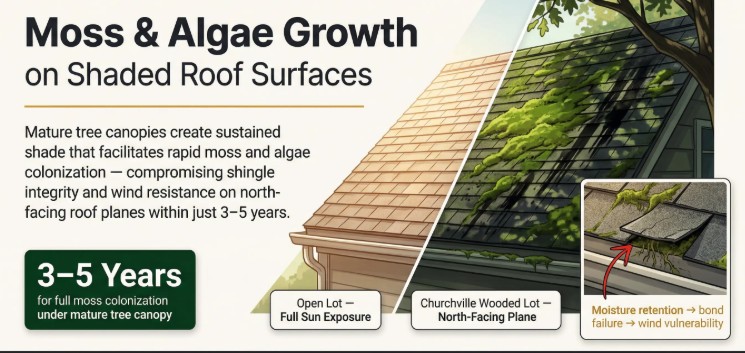
Sign 1 — Moss or Algae Growth Across Shingle Surfaces
On a standard suburban lot, moss requires years of neglect to take hold. On a Churchville estate home surrounded by mature oaks and maples, moss can establish itself on north-facing roof planes within three to five years after a new installation if the conditions are right — sustained shade, retained moisture from debris accumulation, and limited direct sun. Moss is not just an aesthetic problem. The root structure of moss growth lifts shingle tabs from their adhesive strips, breaking the bond that provides wind resistance and water-shedding capacity. A shingle surface that looks intact from the ground but is covered in moss is frequently in significantly worse condition than its age suggests. Annual inspection and treatment of the shaded Churchville roof planes are the correct maintenance standard — not optional.
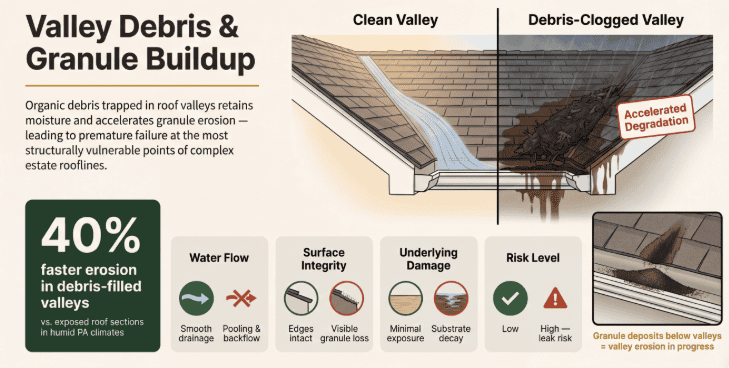
Sign 2 — Valley Debris Accumulation and Staining
The valleys on a Churchville estate home — the V-shaped intersections where two roof planes meet — are the most vulnerable point on any roof. On a wooded-lot property, they are also where the most debris accumulates: leaves, seed pods, small branches, and organic matter that packs into the valley and holds moisture against the roofing material below. Look from the ground for dark staining lines running down from valley intersections, which indicate moisture tracking. Look in the gutters for concentrated granule deposits directly below valleys, which indicates that the valley material is eroding faster than the field shingles. Either pattern warrants a professional assessment of what’s happening under the surface.
Sign 3 — Shingles 20+ Years Old on a Shaded Churchville Lot
Standard architectural asphalt shingles carry a 25–30-year rated lifespan — tested and validated under full solar exposure. On a Churchville estate home with a mature tree canopy that provides significant shade, the moisture-retention dynamics are fundamentally different. Wet shingles that don’t dry within 24 hours after rain events experience accelerated granule adhesion failure and substrate degradation. Realistically, architectural shingles on heavily shaded lots in Northampton Township should be professionally assessed at 18–20 years rather than waiting until the rated 25-year mark.
Sign 4 — Granules Accumulating in Gutters Below Valleys
Standard guidance says to look for granules in gutters as a sign of shingle aging — and that’s correct. But on Churchville properties, the location of the granule accumulation matters. Heavy granule deposits in gutters directly below roof valleys indicate that the valley material is eroding at a faster rate than the field shingles. This is almost always caused by debris accumulation in the valley, which holds moisture against the shingle surface. The valley sections are failing before the rest of the roof, and on a complex estate home roofline, failing valleys threaten the interior at the most structurally sensitive points.
Sign 5 — Missing or Lifted Shingles at Complex Roofline Transitions
On a standard gable roof, wind damage typically lifts shingles on the most exposed weather-facing plane. On a Churchville estate home with dormers, hips, and multiple intersecting planes, the wind dynamics are more complex — shingles at hip ridges, dormer-to-main-roof transitions, and the edges of steep-pitch sections are most vulnerable because these are the locations where the sealant strip bond is most stressed by thermal cycling and where flashing transitions create potential lift points. Look for lifted or missing shingles, especially at these transition zones, not just on the open-field sections.
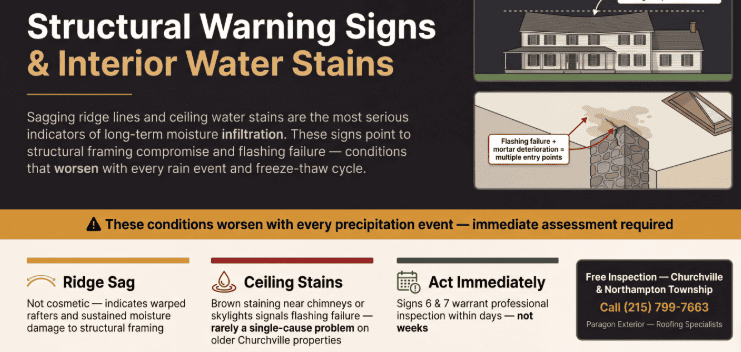
Sign 6 — Interior Water Stains Near Chimneys or Skylights
Water staining on ceilings near chimneys or skylights indicates a flashing failure — almost universally on properties more than 15 years old. Churchville estate homes with original fieldstone or brick chimneys are particularly susceptible to mortar joint deterioration that, in concert with flashing failure, creates multiple simultaneous water-entry pathways. A single stain near a chimney almost never has a single cause on an older Churchville property — the inspection needs to cover the full chimney-to-roof interface, not just the visible stain origin.
Sign 7 — A Sagging Ridge or Soft Sections When Walking the Roof
A ridge line that sags — visible from ground level as a slight dip or bow in what should be a straight horizontal line — indicates structural compromise in the framing below the roofing material. On Churchville’s older estate homes and farmhouses, this is almost always the result of sustained moisture damage to the ridge board or rafter framing from decades of slow water infiltration. This is not a wait-and-see condition. Sagging indicates structural compromise that worsens with each additional precipitation event and each freeze-thaw cycle. A professional assessment is needed immediately.
When to Call Paragon Exterior
Signs 5 through 7 warrant a professional inspection within days. Signs 1 through 4 on a Churchville wooded-lot property warrant annual professional monitoring. Free inspections for all Churchville and Northampton Township properties. Call (215) 799-7663.
Frequently Asked Questions
Does moss on a Churchville roof mean it needs to be replaced?
Not necessarily, but it needs immediate professional attention. Moss indicates sustained moisture retention on the shingle surface, accelerated by Churchville’s mature tree canopy. If caught early, moss can be treated, and shingles beneath may be salvageable. If moss has been present for years and shows visible granule loss, replacement is likely the right call.
How does Churchville’s wooded setting affect roof lifespan?
Significantly. Mature tree canopy increases debris accumulation in valleys, creates sustained shade that prevents wet shingles from drying properly, and introduces branch impact risk during storms. Churchville homeowners on wooded lots should realistically expect a 20–25-year shingle lifespan, compared with 25–30 years on open suburban properties.
Can I repair valley damage on my estate home instead of replacing the full roof?
Valley repair is appropriate when damage is isolated, and the surrounding shingles have adequate remaining life. If valley damage is accompanied by widespread moss growth, deteriorated surrounding shingles, or soft decking beneath the valley, partial or full replacement is the better investment — piecemeal valley repair on an aging roof typically requires repeat treatment within three to five years.
About the Author
Maxwell Martin, CEO, Paragon Exterior LLC
Maxwell Martin has 20+ years of experience in the exterior remodeling industry, specializing in residential and historic roofing across Philadelphia, Bucks County, and the greater Delaware Valley. Paragon Exterior holds PA License #PA197973, GAF certification with access to the Golden Pledge warranty, and a 4.9-star rating across 100+ verified Google reviews.
