
How Roof Replacement Works in Somerton PA: Step by Step
A Plain-English Walkthrough for Both Flat Roofs and Pitched Roofs
Understanding how roof replacement works in Somerton PA before you sign anything is especially important here — because Somerton’s mix of flat-roof row homes and pitched-roof detached homes means the process is genuinely different depending on which type you have, and most homeowner guides describe only one.
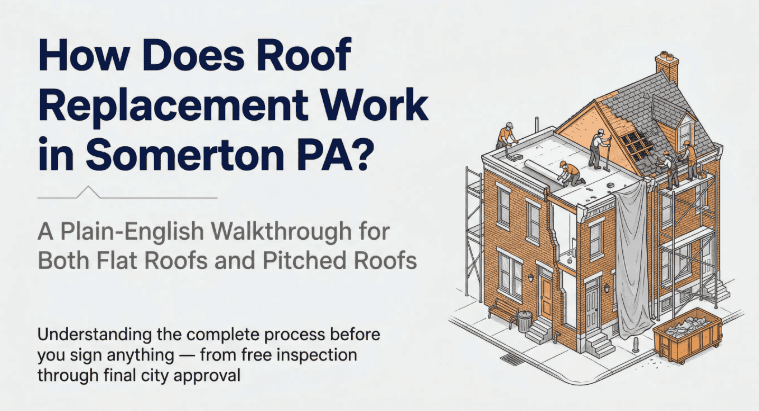
Step 1 — Free Inspection and Assessment (~1–2 Hours)
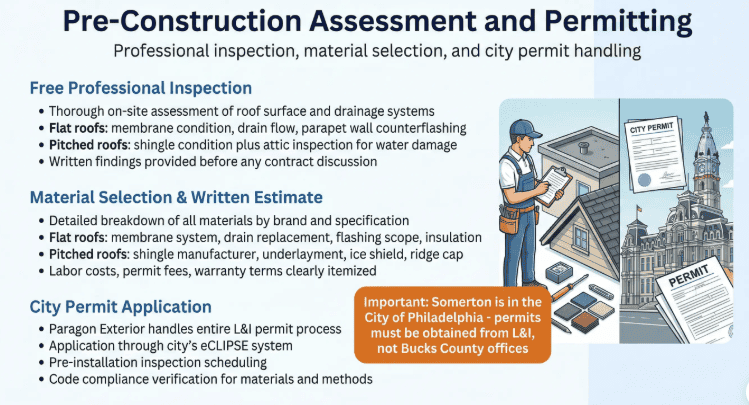
A proper inspection covers the full roof surface — membrane condition for flat roofs and shingle condition for pitched roofs — plus drainage, flashings, and attic access, where applicable. For flat roofs, this means walking the membrane, checking drain flow, and inspecting parapet wall counterflashing on all sides. For pitched roofs, this means a surface walkthrough plus an attic check for staining, soft decking, or ventilation gaps. All Paragon Exterior inspections are free and include written findings before any contract discussions.
Step 2 — Material Selection and Written Estimate (Days 1–3)
For flat roofs, the estimate specifies: membrane system by brand and type (modified bitumen, EPDM, or TPO), number of plies, drain replacement if needed, scope of parapet and cap flashing, and any tapered insulation to correct the slope. For shingle roofs, the estimate specifies: shingle manufacturer and product line, underlayment type, ice and water shield specification, flashing plan, and ridge cap material. Both types include permit fee, debris removal, and warranty terms — in writing before any deposit.
Step 3 — City of Philadelphia L&I Permit Application (5–10 Business Days)
Somerton is in the City of Philadelphia. Full roof replacements require a permit from the Department of Licenses and Inspections (L&I) — not Bucks County, not a township office, but the City permit office. Paragon Exterior handles the L&I application entirely. You don’t interact with the permit office — we apply, schedule the inspection, and close it out at project completion. Skipping the permit is not a time-saving shortcut; it is a code violation that can void warranties and create legal complications at resale.
Step 4 — Property and Neighbor Protection (Morning of Day 1)
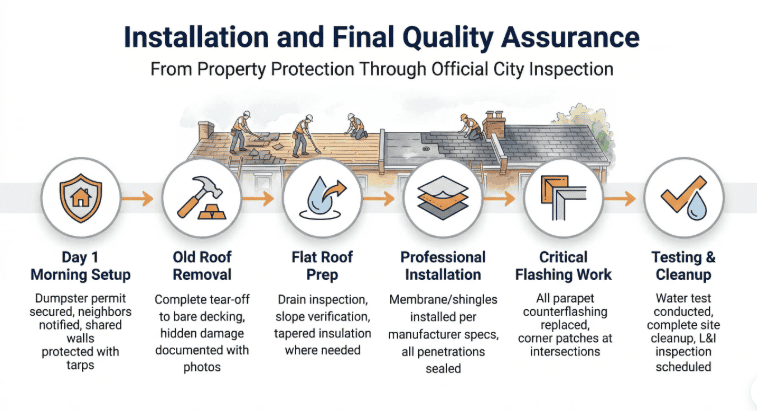
Row home protocol is different from suburban jobs. A dumpster permit is required for most street placements in Philadelphia — Paragon handles this. The crew notifies adjacent neighbors before work begins and protects the shared wall side with ground-level tarps. Debris containment in a row home block requires active management because there is no yard to catch falling material on either side. This operational discipline is what separates experienced Northeast Philadelphia contractors from those who haven’t worked the streets.
Step 5 — Tear-Off and Decking Inspection (Day 1)
The old membrane or shingles are removed to bare decking. This is when hidden conditions are discovered. On flat roofs, the area around drains and parapet walls is most likely to show compromised decking. Pitched roofs, valleys, eave edges, and chimney surrounds are common problem zones. All compromised decking is photographed and documented before replacement — you receive a written record of what was found and what was done.
Step 6 — Drainage and Substrate Preparation (Flat Roofs Only)
Before any new membrane goes on, drains are inspected and replaced if they have deteriorated. The deck slope is verified to confirm positive drainage toward the drain. Areas with insufficient slope may receive tapered insulation boards to correct the drainage geometry. This step is what separates a flat roof that lasts 20 years from one that fails in 7.
Step 7 — New Roof System Installation
For flat roofs: membrane installed in overlapping plies, seams heat-welded or cold-adhered depending on the system, drain collar integrated, and the entire surface inspected before moving to flashings. For shingle roofs: ice and water shield in the first three feet from each eave and all valleys, synthetic underlayment across the remaining deck, shingles installed from bottom to top with offset courses, step flashing at all penetrations, and ridge cap to close the peak.
Step 8 — Parapet and Perimeter Flashing (Flat Roofs)
All parapet wall counterflashing is replaced — not patched. Cap flashing is installed at the perimeter. Corner patches are applied at all right-angle intersections. This step is where many contractors take shortcuts; it is also where most flat roof leaks originate. Paragon Exterior replaces all perimeter flashing as a standard part of every flat roof replacement — never as an optional add-on.
Step 9 — Final Inspection, Cleanup, and L&I Close-Out
The new roof is water-tested before the crew leaves. The street, property, and any shared surfaces are swept clean. The L&I final inspection is typically scheduled within one to two weeks of completion. You receive written documentation of the completed permit, the material warranty registration, and the workmanship warranty.
Tips for Somerton Homeowners During the Replacement
Be home on Day 1 morning. Alert your immediate neighbors 24 hours in advance — they’ll appreciate it. Move any vehicles from the front of your home to allow access for the dumpster and materials. For flat roofs, make sure the roof hatch or access is clear. Call us with any questions at (215) 799-7663.
Frequently Asked Questions
How long does flat roof replacement take on a Somerton row home?
Most flat roof replacements are completed in one to two days. Day one covers tear-off and decking inspection. Day two covers membrane installation, flashing, and drain work. Paragon Exterior provides a specific timeline in every written estimate.
Do I need to notify my neighbor before a row home roof replacement?
It’s both courteous and practically necessary. Row home roof work requires staging on the shared property line side. Paragon’s crew notifies adjacent neighbors before work begins, protects the shared wall from debris, and coordinates access to minimize disruption to the whole block.
Does the City of Philadelphia require an inspection after roof replacement?
Yes. After the L&I permit is issued and work is completed, the City schedules a final inspection to confirm code compliance. Paragon Exterior handles the entire L&I process from permit application through final inspection close-out.
About the Author
Maxwell Martin, CEO, Paragon Exterior LLC
Maxwell Martin has 20+ years of experience in the exterior remodeling industry, specializing in residential and historic roofing across Philadelphia, Bucks County, and the greater Delaware Valley. Paragon Exterior holds PA License #PA197973, GAF certification with access to the Golden Pledge warranty, and a 4.9-star rating across 100+ verified Google reviews.
