
Roof Pitch Calculator
Calculate your roof pitch, angle, and slope with our professional roofing calculator
Roof Pitch Calculator
Vertical measurement
Horizontal measurement
If you know the roof angle directly
Results
Common Roof Pitches
How to Measure Roof Pitch
Material Recommendations by Pitch
Why Roof Pitch Matters
Roof pitch affects water drainage, snow load capacity, material choices, and overall aesthetics. Understanding your roof’s pitch is crucial for:
- Selecting appropriate roofing materials
- Ensuring proper water drainage
- Meeting building code requirements
- Planning for snow load capacity
- Determining installation complexity and costs
Material Recommendations by Pitch
What is a Roof Pitch?
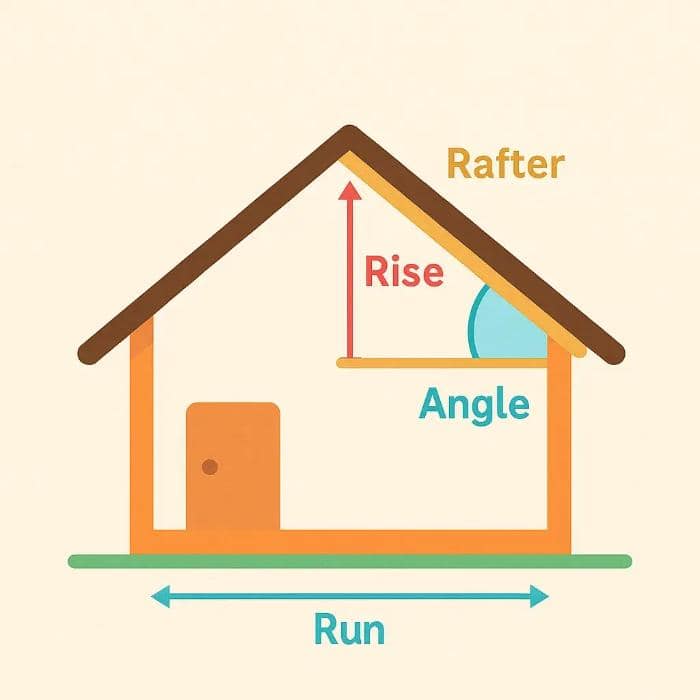
A Roof’s pitch is the slope created by the rafter. It can be measured in two ways
1) As the angle the rafter makes with the horizontal
2) The proportion between the rise and the run of the roof.
Roof pitch is usually expressed as a ratio between rise and run in the form of rise / 12. For example, a pitch of 1:12 means that for every twelve yards of building length, the rise will be equal to one yard.
Types of Roof Pitch
Roofs are classified by their pitch—or steepness. Here’s a breakdown of the most common categories:
Flat Roofs
These aren’t completely flat—they have a slight slope to allow water to drain off. Flat roofs typically range from 0.5:12 to 2:12 in pitch (about 4%–17%).
Low-Pitched Roofs
Any roof with a pitch under 4:12 (or 33%) is considered low-pitched. These require special waterproof materials and are harder to maintain.
Standard/Moderate Pitched Roofs
The most common roof pitch falls between 4:12 and 9:12 (33%–75%). These are easy to build, safe to walk on, and work well with most roofing materials.
Steep or High-Pitched Roofs
Roofs with a pitch greater than 9:12 are considered steep. Some go as high as 21:12 (about 175%). These roofs need extra fasteners and safety precautions during installation.
How to Calculate Roof Pitch
You can figure out your roof pitch using basic math from right triangles. It only takes a couple of measurements—rise and run—to calculate everything you need.
Use these formulas to get started:
rafter² = rise² + run²
pitch = rise / run
pitch = tan(angle)
If you want to convert pitch into the standard x:12 format, just multiply your slope (rise/run) by 12. For example, a pitch of 0.25 turns into 3:12.
You can enter any of these values—rise, run, pitch percentage, or angle—into the calculator, and it will fill in the rest for you automatically.
Roof Slope Calculator – Example of Use
Before jumping into your roof pitch calculations, it’s a good idea to have an angle converter on hand in case you need to switch between degrees and radians. Once that’s ready, here’s how to calculate your roof pitch step-by-step:
First, measure the run—this is the horizontal distance from the outer wall to the center ridge of your roof. Let’s say the run is 6 meters.
Next, measure the rise—this is how tall the roof rises vertically over that same span. In this case, we’ll use 1.5 meters.
To figure out the length of the rafter, plug these numbers into the Pythagorean theorem:
rafter² = rise² + run²
1.5² + 6² = 2.25 + 36 = 38.25
rafter = √38.25 = 6.18 meters
Now calculate the roof slope by dividing rise by run:
pitch = rise / run = 1.5 / 6 = 0.25 or 25%
To convert that slope into an angle, take the arctangent of the pitch:
angle = arctan(0.25) = 14°
Finally, to express the pitch as a ratio (x:12), multiply the slope by 12:
x = 0.25 × 12 = 3
So the roof pitch is 3:12. That’s the same as 25% or 14 degrees.
If you’ve figured out your pitch and you’re ready to move on, you may want to check out our Roof Lifespan Calculator to estimate which material to use.
Roof Pitch Calculator – FAQs
There’s no single standard for roof pitch—it depends on local climate, building styles, and materials. In the U.S., most roofs fall between 4/12 and 9/12 pitch. In the U.K., roofs tend to range from 40° to 50°, though 45° should be avoided for structural reasons. In warmer climates like Italy, common roof angles are between 16° and 25°.
The cost of adding or changing a roof’s pitch depends on the roof’s size, design, access, labor, and materials. In the U.S., asphalt shingles range from $3.19–$4.43 per sq. ft., while wood and metal roofs can range from $7.35–$10.73 per sq. ft. In the U.K., roof fitting averages £72–£75 per square meter. Always get a quote based on your home’s specific conditions.
For snow to slide effectively, a roof should have a pitch of around 6/12 or 7/12 (roughly 30°). However, this isn’t guaranteed—factors like material type, snow direction, and wind also matter. Some roofs with pitches as low as 10° have shed snow, but in snow-heavy areas, a steeper pitch is a safer bet.
A 4/12 pitch means the roof rises 4 inches for every 12 inches of horizontal run. That’s about an 18.5° angle. It’s a gentle slope that allows for decent water runoff but may not be ideal in heavy snow areas. Asphalt shingles are great for this pitch—rubber or wood shingles are not recommended.
The best pitch depends on the design and location of your home. Flat modern roofs often use a 1:40 pitch. Gothic-style roofs are very steep—around 60°. In snowy climates, a pitch of 10/12 (40°) or more helps shed snow. In high-wind areas, safer pitches fall between 4/12 and 6/12.
The lowest practical pitch is 0.5/12. Fully flat roofs aren’t truly flat—they still need a slight slope to drain water. EPDM rubber is commonly used for flat roofs due to its waterproof durability. Flat roofs cost less and require less maintenance but may not last as long as steeper options.
A roof pitch of 30° is about the same as a 7/12 pitch. To convert degrees to x:12 format: take the tangent of the angle, then multiply that value by 12. For 30°, tan(30°) ≈ 0.577, so 0.577 × 12 ≈ 7—making it 7:12.
A roof pitch multiplier, or pitch factor, helps you calculate the actual area of a sloped roof. It’s based on the formula: √((rise/run)² + 1). Multiply your flat roof area by this number to get the true surface area needed for roofing materials. It’s a useful shortcut when estimating supply needs.
A 12/12 pitch means the roof rises 12 inches for every 12 inches across—a perfect 45° angle. To find this, divide the rise by the run (12 ÷ 12 = 1), then calculate the arctangent of 1, which equals 45°.
Roofs with a pitch of 6/12 (about 26.5°) or less are usually safe to walk on without special gear. At 7/12 (30°), walking is possible but requires caution. Slopes between 8/12 and 10/12 are riskier and should be approached with safety equipment. Anything steeper than that isn’t walkable without scaffolding or harnesses.
Yes, but extra steps are needed. A 3/12 pitch roof doesn’t drain water quickly, so it’s more prone to leaks. You’ll need an underlayment or waterproof membrane beneath the shingles. Only use shingles that are rated by the manufacturer for low-slope applications—check the packaging to be sure.
