
Roof Replacement Warning Signs for Penndel Homeowners
What Failure Looks Like on Penndel’s Historic Borough Homes — Including Signs You Won’t Find in Standard Guides
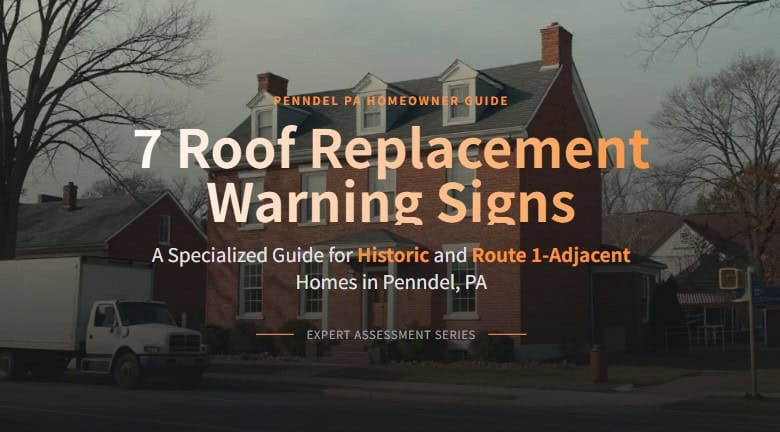
Knowing the 7 Roofing Contractor for replacement signs for Penndel PA homeowners requires different guidance than standard Bucks County roofing checklists provide — because Penndel’s housing stock, concentrated in the pre-WWII and mid-20th century construction era, develops failure modes that simply don’t appear on 1980s suburban colonials, and because the Route 1/Lincoln Highway proximity factor creates accelerated wear patterns at specific roofing components that are invisible from the street and frequently missed in standard assessments.
Sign 1 — Chimney Flashing Separation or Visible Gap at Brick Face
On a Penndel pre-WWII home, the single most critical roof warning sign is not on the shingles — it’s at the chimney. Original masonry chimneys on Penndel borough-era homes are between 80 and 120+ years old. The counterflashing at the brick face has been subjected to decades of thermal cycling, mortar joint deterioration, and — on Route 1-adjacent properties — sustained vibration. Look from the ground, using binoculars, at the line where the metal counterflashing meets the brick. Any visible gap, lifting edge, or surface-applied caulk covering what should be a clean metal-to-brick junction is an active leak pathway waiting for the next heavy rain. Call a pro for: any visible chimney flashing gap or surface caulk over a metal-to-brick transition.
Sign 2 — Loosened or Shifted Flashing at Wall-to-Roof Transitions Near Route 1
This sign is specific to Penndel properties near Route 1 and Lincoln Highway. Sustained commercial traffic vibration transmits through the structure and, over the years, loosens the fasteners holding step flashing and counterflashing at wall-to-roof transitions. The visual indicator is subtle: flashing that’s not fully flat against the wall surface, a slight gap at the top edge of the counterflashing, or (more visibly) rust staining on the exterior wall below the flashing line where water has been wicking under the metal for multiple seasons. Standard inspectors looking only at the shingle surface miss this. Call a pro for: any flashing at wall intersections that is not fully flush or shows rust staining below it.
Sign 3 — Three Visible Shingle Layers at the Eave Edge
Pennsylvania law limits roofs to a maximum of two shingle layers — three layers require a full tear-off before new installation. On Penndel’s historic housing stock, the layer count at the eave edge is the most important thing to check before signing any roofing contract. A pre-WWII Penndel home that received a re-roof in the 1970s and again in the 1990s is likely carrying three layers — original shingles, a 1970s overlay, and a 1990s overlay. Look at the roofline from below at the eave edge: if you can count three stacked shingle courses, every roofing estimate you receive must include a full tear-off scope and cost. Any contractor who quotes on top of three layers is either uninformed or cutting corners. Check this: walk to the eave edge and count visible shingle courses before calling any contractor.

Sign 4 — Granule Accumulation in Gutters After Multiple Storm Events
After every significant rain, check the gutters and downspouts for granule accumulation — the dark, sandy deposits that come off aging shingles. Heavy deposits indicate the shingles’ UV-protective coating is failing. On Penndel homes near Route 1, also look for granule accumulation that is concentrated near vibration transmission points — around chimney bases, at wall-to-roof transitions, and at valley outlets — rather than distributed uniformly across the gutter run. Concentrated granule deposits at vibration points indicate accelerated localized wear, not just general aging. Call a pro if heavy granule deposits appear after major rain events.
Sign 5 — Interior Ceiling Stains in Rooms Beneath the Roof
Water staining on upper-floor ceilings or walls directly beneath the roof surface is always a symptom of a failure that has been occurring for multiple seasons, not a new event. On Penndel’s pre-WWII homes, the most common sources are: chimney counterflashing separation (staining appears near the chimney wall), valley metal failure (staining runs diagonally from the valley toward the exterior wall), and plank decking deterioration in attic spaces that collect moisture from small but sustained entry points. Call a pro immediately if any interior staining is present or has been growing over multiple seasons.
Sign 6 — Shingles 20+ Years Old on a Penndel Pre-WWII Home
Architectural shingles last 25–30 years in Lower Bucks County. On Penndel historic homes, however, the shingles are only one component — the flashings, the chimney counterflashings, and the original plank decking are the other components of the system, and these require assessment on their own independent timeline. A 20-year-old shingle system on a 1930s Penndel home should be professionally assessed not just for shingle condition but for the complete roofing system status — because the flashings and substrate beneath those 20-year-old shingles are 90+ years old and may have been failing slowly long before the shingles show visible symptoms. Schedule an inspection for any Penndel pre-WWII home with shingles installed in the early 2000s.
Sign 7 — Soft Spots, Sagging, or Visible Dips in the Roof Plane
Any visible unevenness in the roof surface — small dips, waves, or a ridge line that sags at any point — indicates structural compromise in the decking or framing beneath. On Penndel’s older homes, this typically means original plank sheathing has deteriorated to the point of losing structural integrity, or in more serious cases, moisture damage has progressed into the rafter framing. This is not a wait-and-see condition. A sagging or wavy roof surface warrants immediate professional assessment, not at the next convenient window. Call a pro immediately if any sagging, dipping, or surface irregularity is visible in the roof plane.
Free Professional Inspection for Penndel Homeowners
Paragon Exterior provides free roof inspections for Penndel Borough homeowners — historic pre-WWII homes, mid-century residences, and all property types in the borough. Call (215) 799-7663.

Frequently Asked Questions
How long do roofs last on historic homes in Penndel, PA?
Architectural shingles last 25–30 years in Lower Bucks County. On historic Penndel homes near Route 1, vibration-related wear on flashings reduces the effective maintenance interval — not the shingle life itself, but the interval between professional flashing inspections. Any Penndel pre-WWII home with shingles installed before 2000 should be professionally inspected annually.
What does Route 1 vibration damage look like on a Penndel, PA, roof?
Route 1 vibration damage typically appears as: loosened or shifted chimney counterflashing, prematurely lifted shingle tabs near vertical wall intersections, and accelerated granule loss near vibration transmission points, rather than the uniform pattern of normal aging. These signs are subtle and require a trained eye — they won’t appear in a standard ground-level inspection.
Should I repair or replace my Penndel, PA, historic home roof?
Repair is appropriate for isolated damage. Replacement is warranted when shingles have aged beyond their service life, when granule loss is widespread, when the home has three shingle layers, or when recurring patches haven’t resolved the underlying problem. A professional inspection determines which path makes financial sense for your specific Penndel property.
About the Author
Maxwell Martin, CEO, Paragon Exterior LLC
Maxwell Martin has 20+ years of experience in the exterior remodeling industry, specializing in residential and historic roofing across Philadelphia, Bucks County, and the greater Delaware Valley. Paragon Exterior holds PA License #PA197973, GAF certification with access to the Golden Pledge warranty, and a 4.9-star rating across 100+ verified Google reviews.
